When a hurricane, flood, or severe storm compromises your home’s structure, the hours and days that follow determine whether the damage remains contained or worsens. Emergency rescue shoring is the temporary stabilization process that prevents a damaged building from shifting, sagging, or collapsing further while you and your team develop a permanent repair plan. For homeowners in coastal and flood-prone regions, understanding how shoring works and when to call for it can be the difference between a structure being saved and one becoming unsalvageable.
Key Takeaways
- Emergency shoring stabilizes storm-damaged structures by redistributing loads away from compromised walls, beams, and foundations.
- Three primary shore types (vertical, raker, and lateral) each address a specific kind of structural failure.
- A thorough damage size-up must happen before any shoring is placed, or the intervention can cause more harm than good.
- Emergency shoring is temporary by design and should lead to a permanent solution such as house lifting, foundation replacement, or structural relocation.
- Professional structural teams with hydraulic lifting equipment can transition directly from stabilization to permanent repair, saving time and reducing risk.
What Makes Emergency Shoring Different from Standard Construction Shoring?
Standard construction shoring is planned. Engineers calculate loads in advance, crews build supports on a known timeline, and the structure is intact throughout the process. Emergency shoring operates under the opposite conditions: the structure is already damaged, loads have shifted unpredictably, and time pressure is real. Rescue shoring must account for cracked bearing walls, failed beams, undermined foundations, and the possibility of progressive collapse, where the failure of one element triggers a chain of additional failures throughout the structure.
This distinction matters because techniques that work during a planned renovation can be dangerous in a post-disaster environment. A damaged structure does not behave the way its original engineering intended. Soil may be saturated and unable to bear loads it once held. Connections between framing members may be loosened or broken. The building may have shifted off its foundation entirely. Every one of these conditions changes how and where shoring must be placed.
“We’ve walked onto sites where a homeowner propped up a sagging floor with a bottle jack and a stack of lumber, thinking they were helping. In reality, they concentrated a massive load onto a single point that the damaged slab underneath couldn’t support. Emergency shoring is a system, not a single prop. Every component has to work together, or the whole thing can fail.” – Jason DeVooght
Which Types of Emergency Shores Are Used After Storm Damage?
Emergency shoring systems fall into three broad categories, each designed to counteract a specific type of structural movement. Selecting the right one depends entirely on what the damage size-up reveals.
Primary emergency shore types and when each applies:
- Vertical shores (post shores and T-spot shores): These support sagging floors, ceilings, and roof systems by transferring downward loads through posts to a stable surface below. After flooding, vertical shores are commonly used when floor joists or ceiling beams have been weakened by water saturation or when supporting columns have shifted.
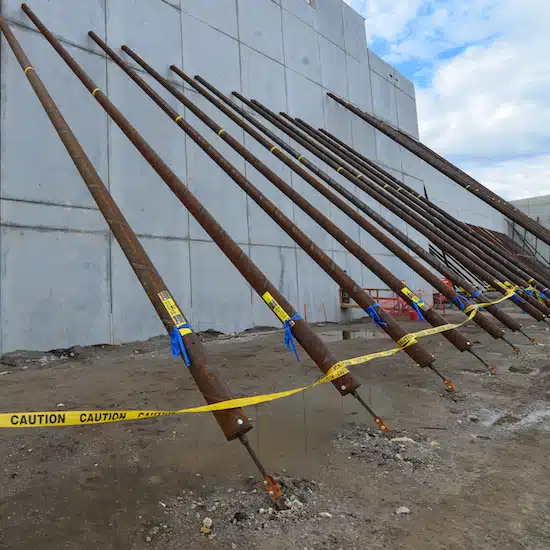
- Raker shores (solid sole and split sole): These brace walls that are leaning, bulging, or at risk of outward collapse. A raker transfers the lateral force from the damaged wall down to the ground at an angle. After high-wind events, raker shores are often the first priority because compromised exterior walls pose an immediate collapse risk to anyone entering the structure.
- Lateral shores (flying shores and cross bracing): These span between two parallel walls or structural elements, using compression to hold both sides in place. They are common in situations where an interior bearing wall has failed, and the remaining walls need mutual support to stay upright.
Each of these systems relies on proper load transfer: collecting the weight from the damaged element through a header, delivering it through posts or struts, and distributing it through a sole plate into a stable bearing surface. If any link in that chain is missing or undersized, the shore itself becomes a hazard. This is why FEMA and the U.S. Army Corps of Engineers require specialized training for anyone performing rescue shoring in collapsed or compromised structures.
What Does a Proper Damage Size-Up Look Like Before Shoring Begins?
No shoring should be placed until someone qualified has assessed the full scope of the damage. A rushed response that skips the size-up often creates new problems. The assessment should follow a six-sided approach, examining the structure from all four sides, the top (roof and upper floors), and the bottom (foundation and crawl space).
Critical elements of a post-storm structural size-up:
- Foundation condition: Check for cracking, displacement, settlement, or undermining from flood scour. A shore placed on a compromised foundation will not hold.
- Bearing wall integrity: Look for out-of-plumb walls (leaning more than 1 inch per 8 feet of height), horizontal cracking at mortar joints, or separation at corners. These indicate the wall is no longer carrying its intended load safely.
- Floor and roof deflection: Sagging floors or rooflines suggest that beams, joists, or trusses have been damaged, overloaded, or lost their connections.
- Secondary collapse indicators: Listen and watch for ongoing movement. Creaking, popping, or visible shifting means the structure has not finished settling. Shoring in an actively moving structure requires additional precautions and monitoring.
“A good size-up saves more homes than any single piece of equipment. We’ve seen structures that looked catastrophic on the outside but were structurally sound once we got underneath and assessed the framing. We’ve also seen homes that looked fine from the street but had foundation damage that made them dangerous to enter. You cannot skip this step.” – The team at DeVooght
If the size-up indicates that the structure has been substantially damaged (meaning repair costs exceed 50% of the building’s pre-storm value), FEMA’s National Flood Insurance Program may require the home to be raised to current base flood elevation standards before any repair permits are issued. This is where emergency shoring transitions from a temporary fix into the first phase of a larger project.
When Does Emergency Shoring Lead to House Lifting or Foundation Replacement?
Emergency shoring is always temporary. It buys time, but it does not solve the underlying problem. For many homeowners in flood zones, the permanent solution that follows emergency stabilization is structural elevation: lifting the home above base flood elevation on a new, code-compliant foundation. In other cases, the foundation itself needs to be replaced entirely, and helical pile systems provide a stable, deep-bearing alternative when surface soils have been compromised by flooding.
“The companies that only do emergency stabilization hand the project off after the building is shored. Then the homeowner has to find a separate contractor for foundation work and another for elevation. We handle all of it. We stabilize the structure, assess whether it can be lifted, and then execute the permanent fix with the same crew and equipment. That continuity matters when you’re trying to get your family back into a safe home.” – David DeVooght
Working with a team that can move directly from emergency shoring to permanent structural work eliminates the gaps, miscommunications, and duplicated costs that come from handing a project off between multiple contractors. It also means the shoring system can be designed from the start to accommodate the lifting equipment and subsequent foundation work, rather than having to be torn out and rebuilt to make room.
How DeVooght Can Help After Storm Damage
The DeVooght team brings more than 55 years of structural stabilization, lifting, and relocation experience to every project, backed by a fleet of 11 Unified Hydraulic Lifting Machines and over 2.5 million pounds of steel beams staged across five equipment locations on the East Coast and Great Lakes region. With 35+ international and regional achievement awards from the International Association of Structural Movers, our crews have the training and resources to stabilize storm-damaged structures and carry the project through to permanent resolution.
If your home has suffered structural damage from a storm, flood, or foundation failure, contact the DeVooght team to discuss stabilization and long-term protection options. Call us at 844-203-9912 or reach out through our website.