North Carolina ranks among the top states in the country for new residential construction permits, with a 6.4% year-over-year increase in single-family authorizations during 2024 according to the National Association of Home Builders. Builders working across the state face a common problem: the ground beneath their projects rarely cooperates. From the sticky red clay of the Piedmont to the loose, saturated sands of the Coastal Plain, NC soils create real complications for traditional foundation methods. Helical pile foundation installation offers builders a faster, code-compliant deep foundation system designed to perform in exactly these conditions. This guide breaks down what NC builders need to know about specifying, installing, and benefiting from helical piles on new construction projects.
What Are Helical Piles and How Do They Work for New Construction?
Helical piles are steel shafts fitted with spiral-shaped bearing plates (called helices) that are rotated into the ground using hydraulic equipment mounted on a mini excavator or skid steer. Think of a large, engineered screw being driven into the earth until it reaches stable, load-bearing soil below the problem layers on the surface. Once seated in firm ground, the pile transfers the structural load from the building above through the shaft and into those deeper, more competent soil layers.
For new construction projects, helical piles serve as the primary deep foundation system. Each pile is installed to a calculated depth where the installation torque confirms the soil can support the required load. That torque reading, taken in real time during installation, gives builders and engineers immediate confirmation that the foundation meets design specifications. No waiting. No guesswork.
“We see builders across the Carolinas discovering that helical piles remove the biggest variable from their foundation work: unpredictable soil. When you can confirm load capacity at the moment of installation, you’re building on certainty, not assumptions.” – The Team at DeVooght
Key components of a helical pile system:
- Lead section: The first shaft segment with helical plates attached, which cuts into the soil during rotation and provides the primary bearing surface at the tip of the pile.
- Extension shafts: Additional shaft segments coupled to the lead section to reach the target depth where competent soil or bedrock exists.
- Helical bearing plates: Spiral plates welded to the shaft, typically 8 to 14 inches in diameter, which distribute the structural load across a wider area of bearing soil.
- Pile cap or bracket: A steel connector at the top of the pile that transitions the load from the foundation structure (such as a grade beam or pile cap) to the helical shaft below.
- Coupling system: A mechanical connection between the lead section and extensions that transfers torque during installation and axial loads during service.
Why Does North Carolina’s Geology Create Foundation Challenges for Builders?
North Carolina’s land divides into three physiographic provinces, each with distinct soil profiles that present different problems for foundation construction. Understanding these regions is not optional for builders working across the state. It directly affects which foundation type will perform and which will fail over time.
The NC Department of Environmental Quality notes that expansive soils can occur throughout all three provinces, with the greatest concentration found in the Carolina terrane and Triassic basins. These ancient sedimentary deposits, formed roughly 220 million years ago when the supercontinent Pangea began to rift apart, contain mudstones and siltstones that swell dramatically when wet and shrink when dry. That cycle puts enormous pressure on shallow foundations.
NC Soil Conditions by Region
| Region | % of State | Primary Soil Type | Foundation Challenge |
|---|---|---|---|
| Coastal Plain | 45% | Sandy, saturated clays, organic soils | High water tables, poor bearing capacity, settlement in soft clay layers |
| Piedmont | 39% | Cecil red clay (expansive), elastic silts | Shrink-swell cycles, low bearing capacity at elevated moisture levels, deep weathering |
| Mountain | 16% | Weathered metamorphic rock, fat clays | Irregular rock depth, frost heave potential, steep slope instability |
Cecil soil, North Carolina’s state soil, covers over 1.6 million acres and dominates the Piedmont region. It is that classic, sticky red clay that stains everything it touches. While Cecil soils are deep and well-drained in their natural state, their high clay content means they absorb water and expand, then contract as they dry. For builders pouring traditional concrete footings, this creates a foundation that shifts with the seasons, leading to cracking, settlement, and structural movement over the life of the building.
Along the coast and east of Interstate 95, the story changes. Engineers working in the Coastal Plain must account for thick layers of soft, saturated clay that can cause significant settlement under load. The water table often sits just a few feet below the surface, making excavation for traditional foundations expensive and complicated. Sandy soils in these areas drain quickly but offer limited bearing capacity for shallow footings, and in areas near Wilmington, limestone layers can halt driven pile installation unexpectedly.
Helical piles address all of these challenges by bypassing the problematic surface soils entirely. The helix plates rotate past the weak layers until they seat into firm, undisturbed ground below, and the installation torque confirms capacity at that depth. For builders, this means the foundation adapts to whatever the soil throws at it, rather than relying on conditions near the surface staying stable over time.
How Do Helical Piles Compare to Concrete Foundations for NC Builders?
Every builder weighs cost, schedule, and performance when choosing a foundation system. Concrete has been the standard for decades, and for good reason: it is well understood, widely available, and inexpensive for simple projects in favorable soil. Where concrete begins to struggle is exactly where NC builders need the most help: in poor soils, tight schedules, and sites where weather delays can wreck a timeline.
Helical Piles vs. Concrete Foundations: Builder Decision Matrix
| Factor | Helical Piles | Poured Concrete | Driven Piles |
|---|---|---|---|
| Installation time | Hours to 1-2 days | 3-7 days (plus 28-day cure) | 1-3 days |
| Load-bearing availability | Immediate | 28 days for full capacity | Immediate |
| Weather dependency | Year-round installation | Rain and cold cause delays | Year-round, but vibration issues |
| Excavation required | None | Significant | Moderate |
| Soil spoils generated | Minimal to none | Large volumes | Moderate |
| Vibration / noise | Low | Low to moderate | High (hammering) |
| Real-time capacity verification | Yes (torque monitoring) | No | Driving resistance only |
| Performance in poor soil | Strong (bypasses weak layers) | Requires soil improvement | Good, but vibration risks |
| Typical cost per pier | $1,500-$2,000 installed | Lower per unit, higher total project cost in poor soil | Higher mobilization cost |
The schedule advantage is where helical piles pull ahead for builders managing tight construction timelines. Concrete foundations require 24 to 48 hours to dry enough for light traffic, and 28 days to reach full load-bearing strength. During that waiting period, no structural work can proceed. Helical piles carry their full design load the moment installation is complete. On a project where the general contractor has subcontractors lined up and every week matters, that difference can save weeks of dead time on the schedule.
“Builders tell us the same thing: they came for the soil performance and stayed for the schedule savings. When your framing crew can start the same day your foundation is finished, that changes the economics of the entire project.” – The Team at DeVooght
Cost comparisons require a wider lens than the per-unit price of each pile. While poured concrete may appear less expensive on a line-item basis, the total project cost in challenging NC soils often favors helical piles. Excavation costs, soil removal and disposal, weather delays, and the extended timeline for concrete curing all add up. For sites with high water tables or expansive clays, soil remediation before a concrete pour can add thousands to the budget. Helical piles skip those steps entirely.
How Does Torque Monitoring Verify Foundation Capacity During Installation?
One of the most significant advantages helical piles offer builders is the ability to confirm load-bearing capacity in real time, during installation, at every single pile location. This is not a theoretical estimate or a post-construction test. It is a direct measurement of how the soil is performing at the exact point where the structure will transfer its load.
The method relies on a proven relationship between installation torque (the rotational resistance the soil exerts against the pile as it is driven deeper) and the pile’s axial capacity (the weight it can support). The standard formula is straightforward: multiply the installation torque (T) by a torque correlation factor (Kt) specific to the pile shaft size, and the result is the ultimate capacity of that pile. Engineers have used this empirical relationship for more than 50 years, and it forms the basis for capacity verification under ICC-ES AC358, the acceptance criteria governing helical pile systems under the International Building Code.
How the torque-to-capacity relationship works in practice:
- Torque is measured continuously: Hydraulic equipment fitted with a torque indicator records resistance as the pile rotates into the ground, typically at 6 to 10 revolutions per minute and advancing at roughly 2 feet per minute.
- Final torque is averaged: The effective installation torque is calculated as the average reading over the last 3 feet of installed depth, measured in 1-foot increments, which captures the conditions at the bearing stratum.
- Capacity is calculated on site: Using the Kt factor for the specific shaft diameter (published by the manufacturer and validated under AC358), the installer or engineer multiplies Kt by T to get the ultimate capacity, then applies a safety factor (typically 2.0) to determine the allowable working load.
- Every pile is individually verified: Unlike concrete foundations where capacity is assumed based on mix design and cure time, each helical pile gets its own confirmed capacity reading. If one pile encounters unexpected soil conditions, the installer simply drives it deeper until the target torque is reached.
Research by Hoyt and Clemence, originally published in 1989 and still foundational to the industry, found that when a safety factor of 2.0 is applied to the torque correlation method, there is a 94% probability that the actual capacity will equal or exceed the predicted value. That level of confidence, confirmed at every pile location on the project, gives builders and structural engineers a degree of quality assurance that concrete foundations simply cannot match without costly load testing.
What Building Code Requirements Apply to Helical Piles in North Carolina?
Helical piles are recognized as a deep foundation system under the International Building Code (IBC) and the International Residential Code (IRC), both of which are adopted in North Carolina. The primary acceptance criteria for helical pile products is ICC-ES AC358, which establishes standards for materials, design, installation, and performance testing.
For builders, code compliance starts with selecting a helical pile product that has a current ICC-ES Evaluation Service Report (ESR). That report confirms the product has been independently tested and evaluated against AC358 requirements, covering axial compression capacity, axial tension capacity, lateral load capacity, and corrosion resistance over a 50-year design life. Major manufacturers like Hubbell/CHANCE, Ram Jack, and Cantsink all maintain current ESR reports.
Code compliance checklist for NC builders using helical piles:
- Product certification: Use only helical pile systems with a current ICC-ES ESR number, confirming evaluation under AC358 and compliance with the 2021 or 2024 IBC.
- Engineering involvement: A registered design professional must specify the pile configuration, helix sizes, target depth, and required capacity based on the structural loads and site-specific soil data.
- Installation documentation: Record torque readings, pile depth, shaft configuration, and any field modifications for each pile installed. This documentation satisfies the quality assurance requirements under AC358 and gives the building inspector a clear record.
- Corrosion allowance: AC358 requires that capacity calculations account for steel thickness loss over a 50-year service life. Hot-dip galvanized coatings or other approved corrosion protection must be specified, and the reduced cross-section is used in all structural calculations.
- Spacing requirements: Multiple piles must maintain a center-to-center spacing at helix depth of at least four times the diameter of the largest helix blade, per AC358 guidance. Pile tops may be closer at ground level if installed at a batter (angled) orientation.
- Load testing (when required): For projects where the code official or engineer requires field verification beyond torque correlation, full-scale axial load tests must comply with IBC Section 1810.3.3.1.2.
“Building officials in North Carolina are increasingly familiar with helical piles and the AC358 criteria. When builders show up with a current ESR, engineered drawings, and torque logs from every pile, the permitting conversation goes smoothly.” – The Team at DeVooght
Which NC Soil Conditions Are Best Suited for Helical Pile Foundations?
Helical piles perform across a broad range of soil conditions, which is part of why they have gained traction among NC builders. That said, certain site conditions make them especially advantageous compared to traditional alternatives. Understanding which scenarios call for helical piles helps builders make the right specification early in the project, before costly delays or change orders hit the budget.
NC Soil Scenarios Where Helical Piles Outperform Traditional Foundations
| Soil Scenario | Where It Occurs in NC | Why Helical Piles Excel |
|---|---|---|
| Expansive clay (shrink-swell) | Piedmont, Triassic basins (Durham, Sanford, Wadesboro) | Piles anchor below the active moisture zone, avoiding seasonal soil movement that damages shallow footings |
| High water table | Coastal Plain, tidewater regions | No excavation needed; piles install through saturated soil without dewatering |
| Loose sandy soil | Outer Banks, Sandhills, coastal counties | Helix plates grip into denser sand layers at depth; torque confirms capacity regardless of surface conditions |
| Soft saturated clay | East of I-95, river floodplains | Piles transfer loads past thick soft clay layers to firm bearing strata below |
| Fill material / disturbed ground | Urban development sites statewide | Piles bypass unpredictable fill to reach undisturbed, natural soil |
| Steep or uneven terrain | Mountain region, western NC foothills | Piles install to varying depths to create a level building platform without major excavation or retaining walls |
A geotechnical investigation (soil boring program) is still strongly recommended before specifying helical piles on any new construction project. The soil report gives the engineer the data needed to select the right shaft size, helix configuration, and target installation depth. It also identifies potential obstacles like limestone layers near Wilmington or shallow bedrock in the Mountains that could affect installation planning.
That said, helical piles offer a unique advantage when soil data is limited. Because the torque correlation method provides real-time capacity data during installation, the system adapts to actual soil conditions encountered in the field. If the boring log predicted firm soil at 20 feet but conditions change across the site, the installer simply drives the pile deeper until the target torque is achieved. This built-in flexibility reduces the risk of costly redesigns or foundation failures that can occur when concrete footings are poured based solely on assumptions from a limited boring program.
What Are the Environmental and Site Advantages for NC Construction Projects?
Beyond structural performance and schedule savings, helical piles offer meaningful advantages for builders working on environmentally sensitive sites or in areas with strict land disturbance regulations. In North Carolina, where coastal wetlands, riparian buffers, and stormwater management requirements shape what builders can and cannot do on a site, these benefits carry real project value.
Environmental and site benefits for NC builders:
- No excavation spoils: Traditional concrete foundations require digging out large volumes of soil that must be hauled off site and disposed of properly. On sites with contaminated soil or regulated fill, disposal costs add significantly to the project budget. Helical piles generate virtually no spoils because the helix plates displace soil laterally as they rotate, rather than removing it.
- Minimal site disturbance: Installation typically requires only a mini excavator, which has a far smaller footprint than the heavy equipment needed for excavation and concrete work. This reduces damage to existing vegetation, grading, and drainage patterns on the site.
- No vibration or noise impact: Unlike driven piles, which use a hammer to pound the pile into the ground, helical piles rotate quietly into the soil. For projects in established neighborhoods or near sensitive structures, this eliminates vibration damage concerns and reduces noise complaints.
- Wetland and shoreline-adjacent installation: Helical piles can be installed in areas where traditional excavation would trigger wetland disturbance permits or violate buffer requirements. Their small equipment footprint and zero-spoils installation make them suitable for coastal and waterfront construction projects.
- Recyclable and removable: Steel helical piles can be unscrewed and removed at the end of a structure’s life, then recycled. For temporary structures or projects where future site restoration is planned, this provides a sustainability advantage over concrete, which must be broken out and disposed of.
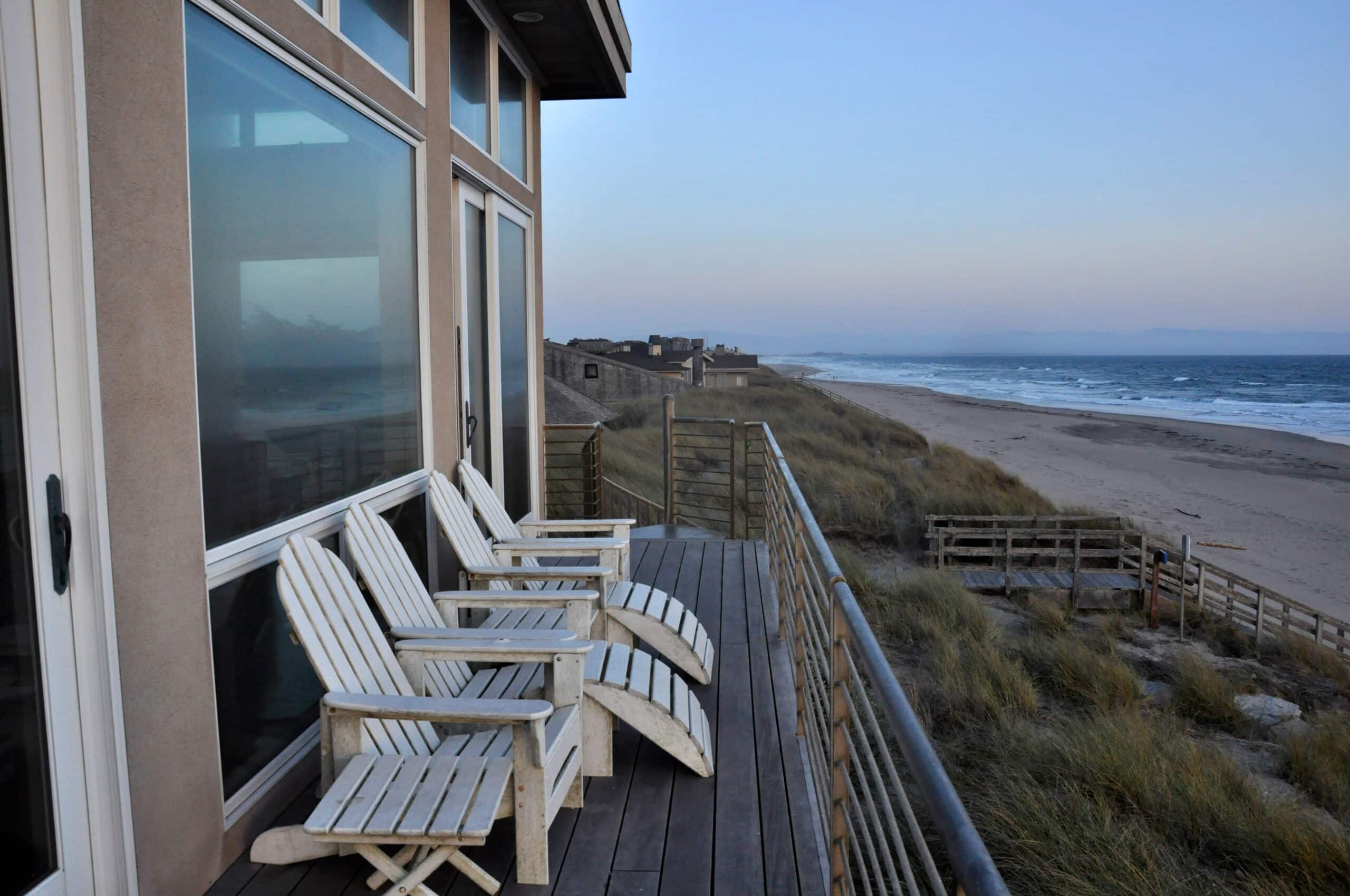
For builders working in NC’s coastal counties, where flood zone regulations often require elevated structures on pilings, helical piles provide a direct alternative to traditional timber or concrete pilings. They install faster, carry verified loads, and perform well in the sandy, saturated soils typical of the Outer Banks, Wilmington, and Beaufort areas.
“On sensitive coastal sites in North Carolina, helical piles let us build strong foundations without tearing up the land to do it. That matters to builders, to homeowners, and to the permitting agencies overseeing these projects.” – The Team at DeVooght
What Should NC Builders Know About Helical Pile Installation Logistics?
Successful helical pile installation depends on three things: a sound engineering plan, the right equipment, and a certified installation crew. For builders evaluating this foundation system for the first time, understanding the installation workflow helps set realistic expectations for schedule, equipment access, and site coordination.
The process begins with the structural engineer or geotechnical engineer specifying the pile layout: the number of piles, their locations, the shaft diameter, helix configuration, target depth, and required capacity. This information comes from the structural load calculations for the building and the soil boring data for the site. The installer uses this specification as the installation plan, with the torque correlation method providing real-time verification that each pile meets the design requirements.
Typical installation workflow for a new construction project:
- Site layout and marking: Pile locations are surveyed and marked according to the engineered foundation plan. Access paths for the installation equipment are confirmed.
- Equipment mobilization: A mini excavator (commonly a Cat 308 or similar) fitted with a hydraulic torque motor and drivehead is positioned at the first pile location. The small equipment footprint allows work in tight spaces and on sites with limited access.
- Lead section installation: The lead section with helical plates is positioned vertically and rotated into the ground. The torque indicator begins recording resistance as the pile advances at roughly 2 feet per minute.
- Extension coupling: When the lead section is fully driven, extension shafts are coupled and the pile continues to advance until the target depth and torque readings are reached.
- Torque documentation: Final torque readings are recorded over the last 3 feet of installation depth. The installer confirms the calculated capacity meets or exceeds the design requirement.
- Pile cap installation: Once all piles are installed and documented, pile caps or brackets are attached to the tops of the shafts, creating the connection points for the building’s foundation structure.
- Immediate construction readiness: With no cure time required, the builder can begin grade beam, pile cap, or slab-on-grade work the same day the piles are completed.
For a typical residential new construction project, a certified helical pile installation crew can complete the entire pile foundation in one to two days. Larger commercial projects take longer, but the per-pile installation time remains consistent. That predictability, combined with zero weather delays from curing requirements, gives general contractors a reliable schedule anchor for the rest of the project.
How Do Helical Piles Support Elevated and Flood Zone Construction in NC?
North Carolina’s coastline and river floodplains put a significant portion of new construction in areas where FEMA flood maps and insurance requirements dictate elevated structures. For builders working in these zones, the foundation must not only support the building, but also raise it above the base flood elevation (BFE) established by local floodplain management ordinances.
Helical piles are well matched for this application because they function as both the deep foundation and the elevation support system. The pile shafts extend from below-grade bearing soil up through the ground surface to the required elevation, with pile caps connecting to the elevated structural frame. This eliminates the need for a separate foundation and elevation system, streamlining both the engineering and the construction process.
For builders constructing in NC flood zones, determining the proper elevation height is a code-driven requirement that affects the entire foundation design. Helical piles can be installed to varying depths and cut to precise elevations at the surface, accommodating sites where the required BFE varies across the building footprint or where the terrain slopes. That adaptability, combined with the ability to install through saturated coastal soils without dewatering, makes them a practical choice for coastal home construction across North Carolina.
Builders considering helical piles for flood zone projects should also account for the connection between foundation type and flood insurance premiums. Structures elevated above the BFE on properly engineered and documented foundations, including helical piles, typically qualify for substantially lower National Flood Insurance Program (NFIP) rates. The torque documentation from each pile installation provides the kind of engineering backup that supports elevation certificate applications and insurance rate reductions.
What Costs Should Builders Expect When Specifying Helical Piles in NC?
Pricing for helical pile foundations depends on several project-specific variables, and builders should evaluate total project cost rather than per-unit price alone. The per-pile installed cost typically ranges from $1,500 to $2,000, with the final number influenced by soil conditions, pile depth, shaft diameter, helix configuration, site accessibility, and the number of piles required.
Factors That Influence Helical Pile Project Costs
| Cost Factor | Impact on Price | NC-Specific Consideration |
|---|---|---|
| Soil conditions | Poor soil = deeper piles = more extensions = higher cost | Coastal Plain sites often need deeper installation than Piedmont sites |
| Shaft diameter | Larger shafts carry heavier loads but cost more per linear foot | Commercial projects in urban areas (Charlotte, Raleigh) may need larger shafts |
| Number of piles | More piles = higher material cost, but better per-unit pricing on larger orders | Elevated coastal homes may need more piles to handle wind uplift loads |
| Site access | Restricted access increases setup time and mobilization costs | Barrier island and waterfront lots in OBX and Wilmington often have limited access |
| Engineering fees | Soil borings and structural design add upfront cost | Required by code; typically $2,000-$5,000 for residential geotechnical report |
Where helical piles often prove more cost-effective than they first appear is in the total project accounting. A builder who avoids excavation, soil removal, soil remediation, concrete forming and pouring, and 28 days of waiting for cure time has saved significant money on labor, equipment rental, and carrying costs. On projects with challenging soil conditions, those savings can offset or exceed the higher per-unit cost of helical piles.
For builders who want to explore how helical piles can work as the foundation for their next NC project, getting a site-specific quote from a certified installer is the best first step. The installer will evaluate soil conditions, access, structural loads, and local code requirements to provide an accurate project estimate.
Conclusion
North Carolina’s booming construction market and its difficult soil conditions create a strong case for helical piles on new construction projects. For builders managing tight schedules in the Piedmont’s expansive clays, the Coastal Plain’s saturated sands, or the Mountain region’s irregular rock, helical piles provide a deep foundation system that confirms capacity at every pile, installs in hours instead of weeks, and eliminates the weather dependency of concrete. The DeVooght team brings hands-on helical pile installation experience across North Carolina, South Carolina, New Jersey, and Wisconsin, with the engineering knowledge and industry recognition to support builders from specification through final documentation. If you need help with foundation solutions for your next construction project, contact the DeVooght team to discuss your site conditions and get a project-specific recommendation.