When your foundation starts to settle, crack, or sink, the fix almost always involves some type of pier system. Two of the most widely used options in foundation repair are helical piles and push piers. Both are permanent steel solutions designed to transfer the weight of your home from weak or shifting soil down to stable ground. The real question is: which one fits your situation? We wrote this guide to walk you through how each system works, when one outperforms the other, and what factors matter most when choosing between them.
What Are the Warning Signs That Your Foundation Needs Repair?
Before you compare pier types, it helps to recognize when your foundation is actually in trouble. Identifying common signs of foundation problems early can save you thousands of dollars and prevent structural failures that put your family at risk. According to the National Association of Homebuilders, roughly 25% of all new homes in the United States will experience some form of structural distress tied to foundation movement during their lifetime. The American Society of Civil Engineers estimates that expansive soils alone cause billions of dollars in property damage each year across the country.
Common indicators of foundation settling or failure:
- Diagonal or stair-step cracks in walls: These cracks often appear in brick, block, or drywall and signal uneven settling beneath the home. Diagonal cracks running from window or door corners are particularly telling.
- Doors and windows that stick or will not close properly: When a foundation shifts, the frame of the house moves with it, causing door frames and window casings to go out of square.
- Uneven or sloping floors: Use a level or simply place a ball on the floor. If it rolls consistently in one direction, the foundation may have settled on that side.
- Gaps between walls and ceilings or floors: Separation at these junctions points to differential movement in the structure, meaning one part is moving while another stays put.
- Leaning chimneys or cracked exterior brick: Chimneys are often the first visible casualty because they sit on a separate footing that can settle independently from the rest of the home.
If you spot two or more of these signs, schedule an evaluation with a licensed structural engineer. They will use laser levels or zip-level altimeters to map exactly where and how much your foundation has moved. That data is what determines whether you need helical piles, push piers, or a combination of both.
“We tell homeowners all the time: the cracks you see today were small cracks a year ago. Foundation problems only move in one direction, and that’s worse. Getting an accurate diagnosis early is the single best investment you can make in your home’s long-term stability.” – The Team at DeVooght
How Do Helical Piles Work and When Are They the Right Choice?
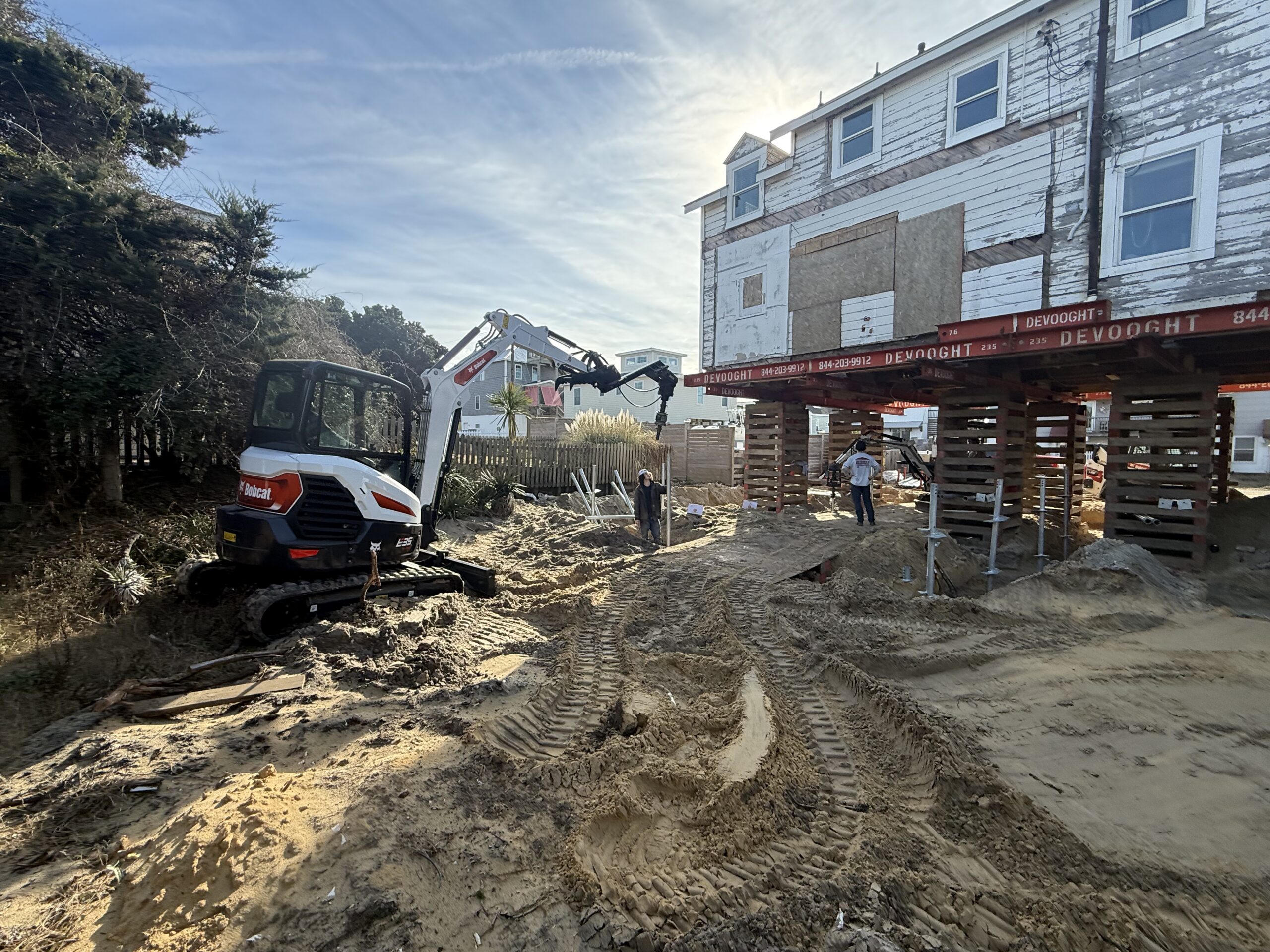
Helical piles (also called helical piers or screw piles) are steel shafts fitted with spiral-shaped plates called helices. Picture a large metal screw being driven into the ground. That is the basic concept. A helical pile foundation is installed by rotating the shaft into the soil using hydraulic equipment attached to a mini-excavator or skid steer. As the shaft turns, the helical plates pull the pier deeper until it reaches a soil layer with adequate bearing capacity. A torque gauge monitors resistance during installation, correlating torque readings to the load capacity of the pier at its final depth.
Once in place, a steel bracket connects the helical pile to the existing footing or foundation wall. The weight of the structure is then transferred through the bracket, down the shaft, and into the stable soil below. Unlike push piers, helical piles do not rely on the weight of the building to reach depth. This makes them the better option for a wide range of structures, from lightweight single-story homes to porches, stoops, and garages.
Situations where helical piles perform best:
- Lighter structures: Homes with one story, wood-frame construction, or homes without reinforced concrete footings do not weigh enough to drive push piers. Helical piles work regardless of structural weight because the torque-driven rotation pulls them into the ground independently.
- Deep bedrock or no bedrock at all: In areas where load-bearing rock sits more than 50 to 100 feet below the surface, or where sandy soils dominate, helical piles are often the more practical solution. The helical plates grip the soil at calculated intervals rather than relying on hitting a rock layer.
- New construction projects: Because helical piles can be installed before a structure exists, they are widely used for deep foundation solutions for builders and contractors working on new residential or commercial projects.
- Angled or battered installation: Helical piles can be installed vertically or at an angle, making them useful for lateral restraint against foundation walls that are bowing or leaning inward.
- Coastal and flood zone properties: In areas with sandy, loose, or water-saturated soils, the helical plate design provides grip that straight-shaft push piers cannot achieve. For homeowners dealing with settling or sagging foundations, helical piles offer a reliable repair in challenging soil environments.
One of the standout advantages of helical piles is their adjustability. If a pier does not reach the expected capacity during installation, the installer can unscrew it and swap to a larger helical plate configuration without losing any material. That flexibility reduces waste and gives the installer real-time quality control during the job.
How Do Push Piers Work and When Should You Choose Them?
Push piers (sometimes called resistance piers or steel piers) are galvanized steel pipe sections driven into the ground using hydraulic pressure. The process starts with excavating soil around the affected section of foundation to expose the footing. A steel bracket is placed under the footing, and a hydraulic ram is attached to the bracket. Sections of steel pipe are then pushed through the bracket and into the earth, one segment at a time, until the pier reaches refusal on bedrock or another competent load-bearing layer.
Here is the critical detail: the weight of the structure itself provides the resistance needed to push those pipe sections downward. That means the building must be heavy enough to counteract the force of the hydraulic ram. If the structure is too light, the ram will lift the house before the pier reaches adequate depth. This is why push piers are typically reserved for heavier structures.
Situations where push piers are the preferred solution:
- Heavy residential and commercial structures: Multi-story homes, large brick or masonry buildings, and commercial properties with reinforced concrete footings provide enough dead-load weight to drive push piers to full depth.
- Shallow bedrock: When load-bearing rock is within 25 to 60 feet of the surface, push piers can be driven to refusal quickly. This makes installation straightforward and keeps costs lower.
- Limited-access areas: Push piers can be installed from inside a basement or crawl space because the hydraulic ram is compact. Helical piles require rotational equipment that needs more clearance, so tight spaces can create problems.
- Built-in load testing: During installation, a pressure gauge monitors the hydraulic force continuously. At final depth, the pressure is held on the pier, performing a real-time load test. This gives the installer and engineer immediate confirmation that the pier can carry the designed load.
Push piers have been used in the construction industry for over a century and remain a trusted solution for heavy-structure stabilization. The galvanized steel resists corrosion, and because the piers reach bedrock or highly compacted bearing soil, they provide strong long-term support. Their main limitation is that they cannot be used on lightweight structures, and they cannot be installed for new construction without specialized pile-driving equipment.
“Choosing between helical piles and push piers should never come down to guesswork or a contractor’s preference for one product. The decision should be driven by engineering: the weight of the structure, the soil profile, the depth to stable bearing, and site access. When all four factors are evaluated properly, the right answer becomes clear.” – The Team at DeVooght
How Do Helical Piles and Push Piers Compare Side by Side?
When you are meeting with foundation repair contractors and reviewing proposals, having a clear comparison helps you ask the right questions. The table below summarizes the key differences between these two pier systems across the factors that matter most to homeowners.
Comparison of Helical Piles vs. Push Piers Across Key Decision Factors
| Factor | Helical Piles | Push Piers |
|---|---|---|
| Installation Method | Rotated (screwed) into soil using hydraulic torque motor | Pushed into soil using hydraulic ram and structure weight |
| Structure Weight Requirement | None; works on light and heavy structures | Requires significant structural weight for installation |
| Typical Depth | 10 to 25 feet (bearing on soil, not bedrock) | 25 to 60+ feet (driven to bedrock or refusal) |
| Best Soil Conditions | Sandy, loose, or mixed soils; deep or absent bedrock | Soils with accessible bedrock or dense bearing layers |
| New Construction Use | Yes; commonly used for new foundations | No (requires existing structure weight or special equipment) |
| Angled Installation | Yes; can be installed vertically or at angles | Vertical only |
| Tension/Lateral Resistance | Yes; resists uplift and lateral forces | No tension resistance without field modifications |
| Limited-Space Access | Requires rotational clearance; tight spaces can be challenging | Compact ram fits in basements and crawl spaces |
| Vibration During Install | Minimal; no vibrations to surrounding soil | Some vibration from hydraulic driving force |
| Average Cost Per Pier (Installed) | $2,000 to $4,000 | $1,600 to $3,000 |
Both systems are designed to be permanent solutions. Both use high-strength galvanized steel, and both transfer the weight of your home from unstable soil to competent bearing ground. The differences come down to how they get there and which conditions each system handles best. A qualified professional structural moving and foundation team will evaluate your specific situation and recommend the system, or combination of systems, that provides the strongest result.
What Role Does Soil Type Play in Choosing Between the Two?
Soil is the foundation beneath your foundation. The composition, moisture behavior, and depth of stable bearing layers beneath your home are the single biggest factors in determining which pier system will perform best. A thorough geotechnical assessment or soil test (typically costing between $1,000 and $3,000) tells the engineer exactly what is going on underground, and this information drives the entire repair plan.
How different soil types affect pier selection:
- Expansive clay soil: Found throughout much of the Southeast, Midwest, and Texas, this soil swells when wet and shrinks when dry. The constant expansion and contraction puts enormous lateral and vertical pressure on foundations. Both pier systems can work in clay, but helical piles often perform better because their plates can be configured to anchor in stable clay layers below the reactive zone.
- Sandy or granular soil: Common in coastal areas of the Carolinas, New Jersey, and the Gulf Coast, sandy soil does not provide much friction for straight-shaft piers. Helical piles grip sandy soil with their spiral plates, making them the preferred choice in these regions.
- Rocky or gravelly soil with accessible bedrock: When solid rock sits within 25 to 60 feet of the surface, push piers can be driven to refusal efficiently. The end-bearing support on bedrock is extremely strong and reliable.
- Mixed or layered soils: Many properties sit on top of alternating layers of clay, sand, silt, and gravel. In these conditions, a structural engineer may recommend a combination of both pier types, or may select helical piles because the flight configuration can be adjusted to match the specific soil profile at each pier location.
For homeowners in North Carolina, South Carolina, Wisconsin, and New Jersey, soil conditions vary widely even within the same county. This is why a site-specific soil analysis and professional engineering assessment are non-negotiable steps in any foundation repair project. Skipping these steps puts you at risk for underperforming repairs that fail within a few years.
“Soil is the story underneath the story. Two homes on the same street can have completely different soil profiles, and the right pier for one house might be wrong for the house next door. We always start with the soil data before we recommend anything.” – The Team at DeVooght
How Much Does Each Pier System Cost and What Drives the Price?
Cost is understandably a top concern for any homeowner facing foundation repair. The U.S. and Canadian foundation repair services market reached roughly $11.8 billion in 2025, according to Future Market Insights, and that number continues to grow at about 5.4% per year. Steel prices, labor costs, and the increasing frequency of soil-related damage from changing weather patterns all contribute to the rising cost of foundation work.
For most residential projects, you can expect to need between 5 and 10 piers, depending on how much of the foundation is affected. Costs scale based on the number of piers, the depth each pier must reach, and local labor rates.
Typical Foundation Pier Costs by Type
| Pier Type | Cost Per Pier (Installed) | Typical Project Total (5-10 Piers) | Best For |
|---|---|---|---|
| Push Piers | $1,600 to $3,000 | $8,000 to $30,000 | Heavy structures with accessible bedrock |
| Helical Piles | $2,000 to $4,000 | $10,000 to $40,000 | Light to heavy structures; varied soil types |
| Concrete Piers | $800 to $1,500 | $4,000 to $15,000 | Lightweight applications (patios, decks) |
Helical piles tend to cost slightly more than push piers because the steel components are more complex (those helical plates add material and manufacturing cost) and the rotational equipment requires additional labor resources. Push piers use simpler pipe sections and a single hydraulic ram, which keeps per-pier pricing lower when conditions allow their use.
Factors that increase your total project cost:
- Depth to bearing soil: Deeper installations require more steel sections and more time, which directly increases cost. This is the biggest single variable in any pier project.
- Number of piers needed: A corner repair might require 3 to 4 piers. A full perimeter repair on a larger home could need 12 to 15 or more.
- Accessibility: Tight crawl spaces, finished basements, or landscaping that must be removed all add labor time and cost.
- Engineering fees: In states like North Carolina, a licensed professional engineer must sign off on the repair plan. Expect to budget $1,000 to $3,000 for engineering services.
- Site restoration: After pier installation, excavated areas need to be backfilled, compacted, and restored. Concrete flatwork, landscaping, or drainage systems may need to be repaired or replaced.
Keep in mind that the cheapest quote is rarely the best value. Accurate pricing includes materials, labor, torque verification or load testing, engineering plans, permits, soil testing, and site restoration. If a quote leaves out any of those items, you are likely comparing apples to oranges. Grants, construction loans, and financing options can help make the investment more manageable.
Can You Use Both Helical Piles and Push Piers on the Same Project?
Yes, and experienced contractors frequently recommend using both systems on the same structure when the conditions call for it. Here is a common example: a two-story masonry home has settled along the rear wall, where it faces a walk-out basement with full height exposure. Along the front of the home, the basement has low overhead clearance and sits on soil with accessible bedrock 30 feet down.
In that scenario, push piers might be ideal for the front, where the structure is heavy, bedrock is reachable, and the compact installation equipment fits in tight quarters. Along the rear, helical piles might be the better option because the walk-out basement wall needs both vertical support and lateral restraint that the helical plates can provide.
Some foundation repair firms only carry one product line. This limits them to recommending the same solution for every project, regardless of conditions. The best contractors stock and install both systems, giving them the flexibility to engineer the right combination for your specific home. A company that offers both helical piles and push piers can select the most effective and most economical solution for each pier location rather than forcing one system to do a job it was not designed for.
When both systems are used together, helical piles can also serve as tiebacks or lateral restraints attached to push piers. The push pier handles the vertical load while the helical pier resists horizontal forces from soil pressure. This combined approach is particularly useful for bowing basement walls in areas with expansive clay soils.
How Does Foundation Repair Affect Your Home’s Value and Insurance?
Foundation damage does not just threaten the structure of your home. It threatens your finances. Homes with unresolved foundation problems can lose 10% to 25% of their market value, depending on the severity of the issue. A $300,000 home could see its value drop by $30,000 to $75,000 if foundation settling is visible during a buyer’s inspection. In many states, sellers are legally required to disclose known foundation problems, which means you cannot hide the issue and hope for the best.
The good news is that properly repaired foundations are not considered a defect. When the work is done by a qualified contractor who provides a transferable warranty, the repair can actually be a selling point. It shows buyers that you addressed the issue with professional-grade materials and engineering oversight.
On the insurance side, a Groundworks survey of nearly 1,000 homeowners found that 78% worry about foundation damage to their home. Standard homeowners insurance typically does not cover foundation repairs caused by normal settling or soil movement. Flood-related foundation damage may be covered under a separate flood insurance policy. House elevation and foundation improvements can affect insurance premiums positively in flood zones, sometimes lowering annual premiums by thousands of dollars for homes that meet or exceed the Base Flood Elevation.
“Foundation repair is one of those investments that pays for itself in multiple ways. You protect the structure, you protect the property value, and depending on your flood zone status, you may even reduce your insurance costs. Ignoring the problem is always the most expensive option.” – The Team at DeVooght
What Questions Should You Ask a Foundation Repair Contractor?
Selecting the right contractor matters as much as selecting the right pier system. A poorly installed pier, regardless of type, will underperform or fail. Here are the questions we recommend asking before signing a contract, drawn from decades of experience in structural work.
Questions to help you evaluate a foundation repair contractor:
- Do you offer both helical piles and push piers? A company that carries both systems can recommend what is best for your home rather than what they happen to sell. If a contractor only offers one product, get a second opinion.
- Will a licensed structural engineer review the repair plan? Engineering oversight is required by law in some states and is best practice everywhere. The engineer should conduct a floor-level survey, review soil conditions, and specify pier type, spacing, and depth for each location.
- How do you verify load capacity during installation? For helical piles, the answer should involve torque monitoring correlated to capacity charts. For push piers, it should involve hydraulic pressure gauges and a hold test at final depth.
- What warranty do you provide, and is it transferable? A transferable warranty protects future buyers and signals that the contractor stands behind their work long-term.
- Are you certified and insured? Look for industry memberships and certifications. For helical piles in particular, ask whether the installer is CHANCE certified or trained through the manufacturer’s certification program.
- Can you provide references from similar projects? A reputable company should have a portfolio of completed projects and be willing to share client references.
Taking the time to vet contractors thoroughly protects your investment and gives you confidence that the repair will last. Our complete guide to helical piles covers the technical details in depth if you want to go further into the engineering side before making a decision.
How DeVooght Can Help With Your Foundation Repair
Foundation repair is not a one-size-fits-all process. Every home sits on different soil, carries a different weight, and faces different conditions. The right approach starts with a thorough assessment and ends with a repair that is engineered for your specific property, not a generic fix pulled from a product catalog.
At DeVooght, our team brings decades of experience in structural lifting, foundation work, and building relocation across New Jersey, North Carolina, South Carolina, and Wisconsin. We are a CHANCE certified helical pile installer, and we work with both helical pile and push pier systems to give every homeowner the solution that truly fits their situation. Whether you are dealing with a settling foundation, planning a new construction project on challenging soil, or looking to raise your house above flood level, our team of structural professionals is here to help.
If your home is showing signs of foundation trouble, or if you simply want a professional evaluation for peace of mind, contact the DeVooght team to discuss your foundation repair needs.