If you have been watching a crack in your drywall spread a little wider each season, or a door that used to close now drags against its frame, you are probably wondering whether you are looking at a cosmetic annoyance or the early stage of an expensive structural problem. House leveling is the process that corrects a home that has settled unevenly, and understanding how it works, what it costs, and when it is the right purchase will help you act before a small correction becomes a major repair. Our team at DeVooght has spent more than 55 years lifting, moving, and stabilizing structures of every size, and in this guide we explain house leveling the way we would explain it across your kitchen table.
Key takeaways from this article:
- Leveling corrects differential settlement. House leveling restores a foundation that has sunk unevenly, while house lifting raises the entire structure to a new height. The two solve different problems.
- The pattern of symptoms matters more than any single sign. One sticking door means little. A sticking door, a sloping floor, and diagonal wall cracks clustered on the same side of the house point to settlement.
- Your foundation type dictates the method. Pier and beam homes are typically re-leveled with adjusted supports and shims, while slab homes usually require piers or injected material beneath the concrete.
- Quotes vary because pricing models vary. Contractors price by the pier, by the square foot, or by crew days. Minor corrections can run a few thousand dollars, while pier-supported leveling of a badly settled home can exceed $30,000.
- The soil question decides whether the fix holds. Re-leveling a structure without addressing the soil condition that caused the settlement invites the problem back.
- Sometimes leveling is the wrong purchase. A settling home in a flood zone may be better served by a full lift onto a new foundation than by leveling alone.
What Is House Leveling, and How Is It Different From House Lifting?
House leveling returns a settled foundation as close as practical to its original plane. When soil beneath a home compresses, washes out, or shifts, one section of the foundation drops while another stays put. Engineers call this differential settlement, and it is the root condition behind almost every leveling project. The structure above telegraphs that movement into floors, walls, door frames, and rooflines.
House lifting is a different service with different goals. A lift raises the entire structure, often several feet, to build a new foundation beneath it or to move the living space above base flood elevation. Leveling corrects inches of uneven movement; lifting creates feet of new height. The two get confused constantly, partly because both rely on hydraulic jacks and structural cribbing, and partly because many foundation companies only offer one and describe it in terms of the other.
We are one of the few companies that performs both, which shapes how we diagnose a settled home. A house that has dropped two inches at one corner is telling you something about the soil under that corner, and the honest answer might be shimming, might be piering, and occasionally might be a full house lift onto a new foundation. Reading the symptoms correctly is where every good leveling project starts.
How Do You Know Your Home Actually Needs Leveling?
Most homeowners find us after noticing one or two symptoms, but a single sign rarely tells the whole story. Seasonal humidity can swell a door frame. A hairline crack can appear in drywall as lumber dries. What separates normal movement from settlement is the pattern: multiple symptoms, clustered in one area of the home, that worsen over time instead of cycling with the seasons.
Symptoms that point toward settlement when they appear together:
- Sloping or dipping floors. Set a marble on the floor in several rooms. If it consistently rolls toward the same side of the house, the structure is tilting in that direction, not just flexing locally.
- Doors and windows that stick on one side of the home. Frames rack out of square as the foundation beneath them drops, so the affected openings usually cluster near the settled area.
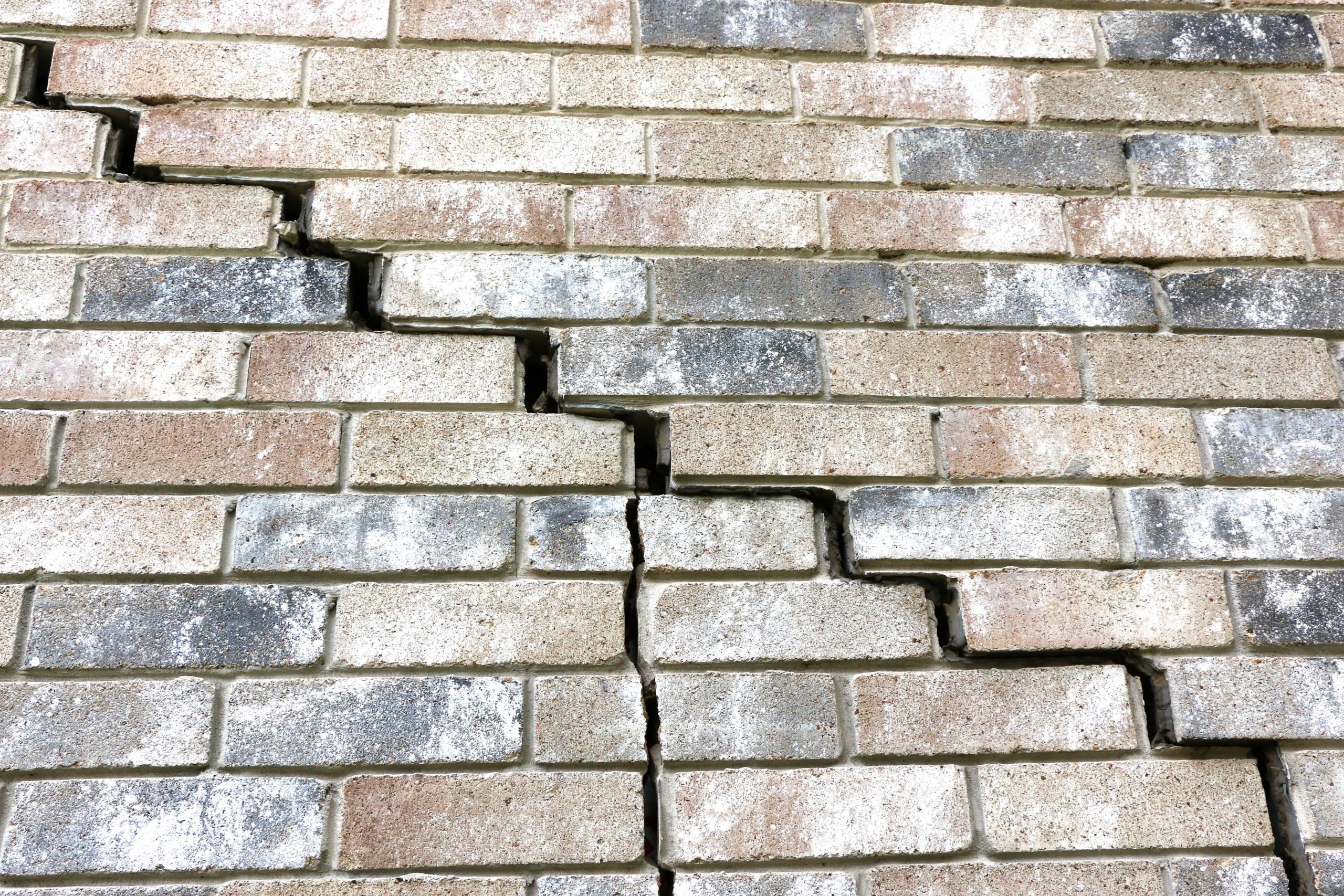
- Diagonal cracks radiating from door and window corners. Vertical hairlines are common in any home. Diagonal cracks that widen at one end signal that one part of the wall is moving relative to another.
- Gaps between walls, floors, or ceilings. Trim pulling away from the wall or a countertop separating from the backsplash shows the structure is no longer sitting on one plane.
- Cracks in the foundation itself. Stair-step cracks in block foundations and widening cracks in poured walls deserve a professional look regardless of other symptoms.
Direction matters as much as the symptoms themselves. If everything you have noticed sits on the side of the house with poor gutter drainage, a large tree, or recently disturbed soil, you have likely found your cause and your settled zone at the same time. Our article on the common signs of foundation problems covers the full diagnostic list in depth.
“Homeowners tend to ask us about the crack. We ask about everything around the crack. Which way the floor slopes, where the downspouts discharge, what the soil does after a hard rain. Settlement always leaves a pattern, and the pattern tells you what the fix needs to be.” – the team at DeVooght
Once the pattern confirms settlement, the next question is mechanical: how do you physically bring a house back to level? The answer depends on what the house is sitting on.
How Does House Leveling Work on Different Foundation Types?
There is no single leveling method, because there is no single foundation. The right approach follows the load path: where the weight of the home travels into the ground, and where that path has failed.
For pier and beam homes, the structure rests on a grid of posts and beams above a crawl space. Leveling here typically means jacking the beams back to plane, then adjusting, shimming, or replacing the supports beneath them. Rotted wood posts and sunken masonry piers are common culprits, and access through the crawl space makes this the most contained form of leveling. Our page on pier and beam lifts explains how we support these structures during the work.
For concrete slab homes, the correction happens beneath the concrete. Minor voids can be filled by pumping grout or expanding polyurethane foam under the slab, which lifts it back toward plane. Deeper settlement calls for piers: steel push piers or helical piers driven past the unstable soil to load-bearing strata, then used as fixed points to raise and permanently support the foundation. Because a helical pier transfers the home’s weight to soil that is not moving, it addresses the cause rather than the symptom, which is why we became a CHANCE Certified Installer and put that system at the center of our helical pile installation service. Homes with cracked or deteriorating slabs may need concrete work alongside the leveling, which we cover in our guide to slab foundation repair methods.
Whatever the method, control is everything. The same synchronized hydraulic jacking systems we use to lift homes weighing more than 160 tons give us fine control when a leveling job calls for a correction measured in fractions of an inch. Raising one point of a house faster than another is how new cracks get created during a repair, so lifting slowly and evenly is not a preference, it is the standard. This is also why leveling is never a homeowner project. The loads involved can shift without warning, and we have written about the dangers of DIY house jacking for exactly that reason.
“The jack does the lifting, but the plan does the leveling. Before we touch a house, we map the elevations across the entire floor plan so we know precisely how far each point needs to travel. Guesswork at the jack is how a repair turns into a second repair.” – Jason DeVooght
Method also drives price, which brings us to the question most homeowners actually typed into the search bar.
What Does House Leveling Cost, and Why Do Quotes Vary So Much?
Search for house leveling cost and you will find figures from $3,000 to $30,000 and beyond, which reads like the industry cannot make up its mind. The real explanation is that contractors use three different pricing models, and each one describes a different kind of job.
The three pricing models behind the numbers you see online:
- Per-pier pricing. Piering contractors commonly charge $1,500 to $2,500 per pier installed. A moderately settled home might need six to twelve piers, so pier-supported leveling often lands between $10,000 and $30,000.
- Per-square-foot pricing. Grout and foam injection under a slab is usually priced by area, often $3 to $8 per square foot. This is why minor slab corrections can come in at $3,000 to $7,000.
- Crew-day pricing. Pier and beam leveling is frequently priced by labor, with a full crew running roughly $2,000 per day. A contained shimming job might take two days, while widespread beam replacement takes a week or more.
The factors that push your project toward the low or high end:
- How far the home has settled. A half-inch correction and a four-inch correction are different projects with different risks.
- Foundation type and access. An open crawl space costs less to work in than a finished slab home where landscaping, decks, or interior floors block access.
- Soil conditions. Piers must reach stable strata. Deeper strata means more pier sections and more labor.
- Related repairs. Plumbing leaks under a slab, rotted beams, or drainage corrections add scope, but skipping them undermines the leveling itself.
- Engineering and permits. Inspection reports and permit fees typically add several hundred to a couple thousand dollars, and they protect you by documenting the repair for future buyers.
When you compare quotes, make sure you are comparing the same repair. A $6,000 foam quote and a $22,000 helical pier quote are not competing bids; they are different answers to the soil question. Foam fills the void that exists today. Piers carry the home past the soil that created the void. If the settlement cause is still active, the cheaper repair is often the more expensive one over a ten-year horizon, because you buy it twice.
“We treat leveling as a load-path problem, not a floor-height problem. Anyone can raise a low corner. The work that matters is making sure the weight of that corner lands on something that will not move again.” – David DeVooght
There is one more cost comparison worth making before you sign anything: the comparison between leveling and not leveling at all, but lifting instead.
When Is Leveling the Wrong Purchase?
Because we perform full structural lifts and relocations along with foundation stabilization, we can say something most pier companies will not: leveling is not always the right way to spend your money. If your settled home also sits in a flood zone, carries rising flood insurance premiums, or has taken water damage before, correcting the foundation while leaving the house at its current height fixes one problem and ignores the more expensive one. In that situation, a full lift onto a new elevated foundation addresses the settlement and the flood exposure in a single project, and it can reduce insurance costs for decades. Our breakdown of the cost of house lifting lets you run that comparison with real numbers.
Leveling is also the wrong tool when the foundation itself is failing rather than settling. Crumbling concrete, widespread spalling, or collapsed footings call for foundation replacement or reconstruction, and jacking a house to level on top of failing material only relocates the stress. An honest assessment sorts these situations out before any equipment shows up, which is why we start every project with elevation mapping and a soil review instead of a sales pitch.
How the DeVooght Team Can Help
Our team brings more than 55 years of structural lifting experience, a fleet of eleven Unified Hydraulic Lifting Machines, and CHANCE certified helical pile installation to every leveling assessment, so the recommendation you get is based on what your home needs rather than the one service a contractor happens to sell. If your floors slope, your doors stick, or your walls are telling you the foundation has moved, we will help you figure out your best next step. Contact the DeVooght team for help with foundation repair or house leveling by calling 844-203-9912 or reaching out through our contact page.