
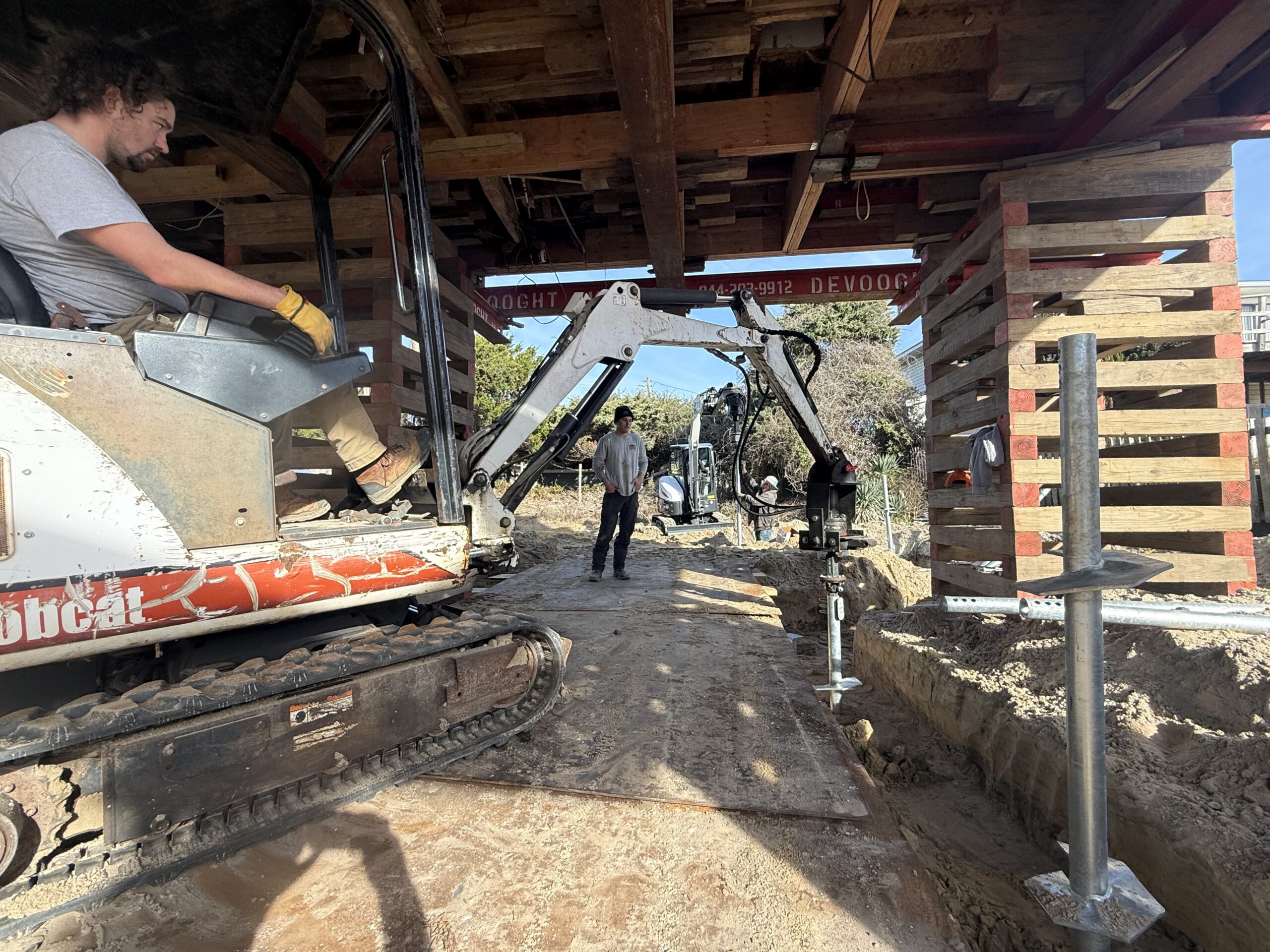
When a helical pile foundation goes into the ground, there is one measurement that tells you more about its strength than any other: installation torque. Torque monitoring during helical pile installation gives your contractor and engineer real-time proof that each pile is anchored into soil strong enough to support your home. Without it, you are relying on assumptions about what is happening below the surface. With it, you have verifiable, site-specific data confirming your foundation will perform as designed. Whether you are building new, stabilizing a settling home, or elevating a property in a flood zone, understanding what torque monitoring reveals puts you in a stronger position as a homeowner.
What Is Torque Monitoring in Helical Pile Installation?
Torque monitoring is the process of measuring the rotational force required to screw a helical pile into the ground during installation. As the pile advances through the soil, the helical plates on the steel shaft encounter increasing resistance from denser, more compact earth layers. That resistance is measured as torque, typically recorded in foot-pounds (ft-lb).
Think of it this way: when you drive a wood screw into a piece of oak, the resistance you feel through the drill is much greater than when you drive that same screw into pine. The same principle applies underground. As a helical pile reaches harder, denser soil strata, the torque value climbs. That climbing torque is direct evidence that the pile is reaching load-bearing ground.
Contractors record torque readings at regular intervals throughout the installation process. At a minimum, readings are taken at the end of each lead section and extension. For more demanding projects, readings may be captured every foot of depth to build a complete soil strength profile. This data is documented and provided to the engineer of record, creating an installation log that serves as both a quality control tool and a permanent record of foundation performance.
“We treat every torque reading as a conversation with the soil. It tells us where we are, what the ground is made of at that depth, and whether the pile has reached the bearing layer it was designed to reach. That real-time feedback is what separates helical pile installation from pouring concrete and hoping for the best.” – The Team at DeVooght
Key components of the torque monitoring process:
- Installation torque: The rotational resistance measured as the helical pile advances into the ground, expressed in foot-pounds.
- Torque readings at intervals: Data points captured at each lead section, extension, or per-foot of depth, depending on project requirements.
- Installation log: A documented record of torque values, pile depth, and GPS location that becomes part of the project’s permanent foundation file.
- Real-time feedback: Immediate insight into subsurface conditions that allows the installer to adjust depth, configuration, or pile placement during the work.
How Does the Torque-to-Capacity Relationship Work?
The connection between installation torque and a helical pile’s load capacity is not a guess or a rule of thumb. It is an empirical relationship backed by over six decades of field testing and research, originally developed by the A.B. Chance Company in the late 1950s and 1960s. The principle gained formal recognition when Hoyt and Clemence published their findings at the 12th International Conference on Soil Mechanics and Foundation Engineering in 1989, analyzing 91 helical pile load tests across 24 different sites and soil types.
The relationship is expressed through a straightforward formula:
Qu = Kt × T
In this equation, Qu represents the ultimate geotechnical capacity of the pile (in pounds), Kt is the empirical torque correlation factor (measured in ft⁻¹), and T is the final installation torque (in ft-lb). The Kt factor is primarily determined by the shaft diameter of the helical pile, and it decreases as shaft size increases.
Default Kt factors recognized by ICC-ES AC358:
| Shaft Type & Size | Kt Factor (ft⁻¹) |
|---|---|
| 1.5 to 1.75-inch solid square shaft | 10 |
| 2.875-inch OD round shaft | 9 |
| 3.0-inch OD round shaft | 8 |
| 3.5-inch OD round shaft | 7 |
To put this into practical terms: if a 2.875-inch round shaft helical pile reaches a final installation torque of 6,700 ft-lb, the estimated ultimate capacity is 6,700 × 9 = 60,300 pounds. Apply a factor of safety of 2.0, and the allowable working load is approximately 30,000 pounds per pile. That is a significant amount of support verified during installation, before the structure is even placed on it.
Independent lab CTL|Thompson compiled data from over 800 full-scale load tests conducted across multiple helical pile manufacturers and confirmed that the torque-to-capacity trend holds consistently across shaft sizes. More recent research by Souissi, Cherry, and Siller (published via the Deep Foundations Institute) refined the model further, developing a modified correlation factor (Km) that accounts for helix configuration, axial load direction, and shaft geometry in addition to diameter. Their findings showed that the standard Kt values in AC358 tend to underestimate pile capacity at lower torque values and overestimate it at higher torque values, reinforcing the value of site-specific load testing on larger or more complex projects.
“The formula itself is simple, but that simplicity is built on top of decades of tested, proven data. When we hand a homeowner their torque logs, we are giving them documentation that ties directly to their foundation’s verified strength. There is no equivalent in traditional concrete work.” – The Team at DeVooght
What Do Different Torque Readings Actually Mean?
Torque readings during helical pile installation are not just numbers on a gauge. They paint a detailed picture of subsurface soil conditions at your specific building site. Understanding what those readings indicate helps both the installer and the homeowner grasp what is happening beneath the surface in real time.
Common torque scenarios and what they indicate:
- Steadily increasing torque with depth: This is the most common and desirable pattern. It indicates that the helical plates are advancing through progressively denser soil layers, building resistance and confirming the pile is reaching its target bearing stratum. On most residential projects, torque climbs as the pile passes through softer surface soils and enters compacted sand, clay, or weathered bedrock below.
- Sudden spike in torque: A rapid jump in torque can indicate the pile has hit a dense layer such as compacted gravel, ceite hardpan, or bedrock. Depending on the project specifications, this may signal the pile has reached sufficient bearing capacity, or it may require the installer to evaluate whether the pile can penetrate further. In some cases, specialized lead sections (such as rock-cutting tips) can advance through these layers.
- Sudden drop in torque after high readings: This scenario is a red flag. When torque climbs and then drops sharply, it can mean the pile has broken through a hard layer into a softer zone below, or that the pile has “spun out” on a rock surface it cannot penetrate. In this situation, the installer and engineer need to evaluate whether the pile is seated in adequate bearing material or if alternative measures are needed.
- Consistently low torque: If torque remains low throughout installation, the pile is moving through weak or loose soil without reaching a competent bearing layer. The installer may need to extend the pile with additional shaft sections to reach firmer ground, or the engineer may need to revise the design to account for the actual soil conditions.
- Torque exceeding the pile’s structural rating: Every helical pile has a maximum torque rating determined by its shaft material and diameter. Over-torquing beyond this limit can twist or damage the shaft, compromising the pile’s structural integrity. Monitoring prevents this by giving the installer a clear ceiling to stay below.
The beauty of this system is that it provides information during installation, not after. If a pile encounters unexpected conditions at one location, the contractor can adapt in real time by adjusting depth, adding extensions, or modifying the helix configuration. This stands in sharp contrast to concrete foundations, where you pour and cure first, and discover problems weeks or months later if the soil beneath was not what you expected.
| Torque Pattern | What It Indicates | Typical Action |
|---|---|---|
| Steadily increasing | Advancing into denser, stronger soil | Continue to target torque value |
| Sudden spike | Hard layer (gravel, hardpan, bedrock) | Evaluate penetration; may use rock-cutting lead |
| Spike then drop | Broke through hard layer into softer soil | Engineer review; may need deeper installation |
| Consistently low | Weak or loose soil throughout | Add extensions to reach bearing stratum |
| Approaching structural limit | Risk of over-torquing and shaft damage | Stop; evaluate pile size or site conditions |
What Equipment Is Used to Monitor Torque During Installation?
Accurate torque measurement depends on reliable equipment calibrated for jobsite conditions. The tools range from simple mechanical gauges to advanced wireless data acquisition systems, and the choice often depends on project size, code requirements, and the level of documentation needed.
At the most basic level, a pressure gauge mounted on the hydraulic drive head is the simplest method. The gauge reads the hydraulic pressure difference across the motor during installation, and a pre-programmed chart converts that pressure to a torque value based on the specific drive head’s gear motor multiplier (GMM). This method is cost-effective and widely used on residential projects. Its accuracy depends on regular calibration and the operator’s attention during installation.
A step up from this is a mechanical torque indicator, often called a shear pin indicator, which provides a more direct measurement of the torque being applied to the pile shaft. These devices sit between the drive head and the pile, measuring rotational force at the connection point. They are more accurate than pressure-based readings because they bypass variables introduced by the hydraulic system itself, such as line losses or motor efficiency changes.
On larger commercial or critical projects, electronic torque monitoring systems offer the highest level of precision and documentation. Systems like the Auger Hawk (manufactured by Datum Electronics) use non-contact sensors to measure torque, thrust, angle, RPM, and installation depth simultaneously. The data transmits wirelessly to a mobile device, where it is logged in real time along with GPS coordinates. This creates a traceable, time-stamped record for every pile installed on the project, which can be invaluable for regulatory compliance, insurance documentation, and long-term maintenance records.
Comparison of torque monitoring equipment types:
- Hydraulic pressure gauge: Reads hydraulic pressure and converts it to torque using the drive head’s GMM. Affordable and practical for most residential work, though accuracy depends on calibration and system condition.
- Mechanical torque indicator: Directly measures rotational force at the shaft connection. More accurate than pressure-based readings. Commonly used when project specs call for tighter tolerances.
- Electronic data acquisition system: Wireless sensors capturing torque, thrust, depth, RPM, angle, and GPS in real time. Produces comprehensive digital records. Best suited for large, complex, or code-critical projects.
“The equipment you use to measure torque matters. A pressure gauge can get you close, but on projects where documentation and accuracy are non-negotiable, you need a system that logs everything digitally. We have seen cases where a homeowner’s insurance claim hinged on having detailed installation records showing verified torque at every pile location.” – The Team at DeVooght
How Does Torque Monitoring Compare to Load Testing?
Torque monitoring and load testing are two of the three recognized methods for verifying helical pile capacity under the International Building Code (IBC Section 1810.3.3.1.9). The third method is theoretical bearing capacity calculation using geotechnical soil data. Each approach has strengths, and most engineers recommend using at least two of these methods for reliable verification.
Torque monitoring offers a distinct advantage in speed and cost. It happens during installation, adding no extra time or setup to the project. Every pile on the job gets measured, giving you 100% coverage of the foundation system. It is particularly valuable on sites where soil boring data is limited or unavailable, because the torque readings themselves serve as a proxy for soil strength, revealing what the ground is made of as the pile advances through it.
Load testing, by contrast, is a post-installation verification performed on one or more representative piles. Compression load tests follow ASTM D1143, while tension tests follow ASTM D3689, and lateral tests follow ASTM D3966. These tests involve applying incremental loads to an installed pile and measuring deflection until the pile either reaches its rated capacity or shows signs of failure. Load testing is the most accurate method for confirming pile capacity because it measures actual performance under real conditions.
The trade-off is that load testing is more time-consuming and expensive. A full-scale compression test requires installing the test pile plus four reaction anchors, assembling a load frame, and running the test sequence. For large commercial projects, the cost and time are justified by the increased confidence and the potential to reduce the total number of piles needed (because tested piles can use a lower factor of safety of 2.0 instead of 3.0 for untested piles). For typical residential projects, torque monitoring alone, combined with the well-documented Kt factors from AC358, provides adequate verification.
| Factor | Torque Monitoring | Full-Scale Load Testing |
|---|---|---|
| When it happens | During installation | After installation |
| Coverage | Every pile on the project | Selected test piles only |
| Additional cost | Minimal (built into installation) | Significant (equipment, setup, labor) |
| Additional time | None | Hours to days per test pile |
| Accuracy | Empirical (based on Kt correlation) | Direct measurement of actual performance |
| Factor of safety allowed | Typically 2.5 to 3.0 | Typically 2.0 |
| Best for | Residential and standard commercial | Large commercial, high-load, or atypical soil |
The takeaway is that torque monitoring and load testing are not competing methods. They are complementary. Torque monitoring gives you broad, real-time quality control across every pile, while load testing gives you pinpoint verification of actual capacity at selected locations. On many projects, the torque data collected during installation is later correlated with the load test results to establish a site-specific Kt value that may differ from the default AC358 factors, fine-tuning the foundation design for that particular soil profile.
Why Should Homeowners Care About Torque Data?
If you are a homeowner investing in a helical pile foundation, the torque data from your installation is one of the most valuable documents you will receive. It is not just a technicality for the engineer. It has practical implications for your property’s safety, value, and future maintenance.
Reasons homeowners should request and keep their torque monitoring records:
- Foundation capacity verification: Your torque logs prove that each pile reached the bearing layer specified in the engineering design. This is something concrete foundations simply cannot provide. With poured concrete, you trust that the soil beneath the footing will hold, but you do not get a measured, pile-by-pile confirmation during the pour.
- Insurance documentation: For homes in flood zones or coastal areas, having detailed foundation installation records strengthens your position when working with insurance adjusters. Torque logs, paired with an elevation certificate, demonstrate that your home’s foundation meets or exceeds code requirements.
- Property value support: When it comes time to sell, buyers and their inspectors want evidence that the foundation is sound. Torque monitoring data, combined with the engineer’s design report, provides third-party-verifiable proof of foundation quality. This can be a meaningful differentiator in coastal or flood-prone real estate markets where resale value depends on foundation integrity.
- Peace of mind for future work: If you ever need to add to your home, renovate, or make structural changes, the torque data tells your future contractor and engineer exactly what the existing foundation can support. There is no need to guess or perform invasive testing on piles that are already in the ground.
- Code compliance record: Many jurisdictions in flood-prone states require documentation showing that deep foundation installations meet local building code and FEMA base flood elevation requirements. Torque logs serve as part of that compliance package.
The cost of helical pile installation already includes torque monitoring as part of the standard process. You are not paying extra for this data. So the question is not whether you should care about it, but whether your contractor is capturing it properly, presenting it clearly, and giving you copies for your permanent records.
“We give every homeowner a complete torque log for their project. It goes in your filing cabinet right next to your elevation certificate and insurance policy. Years from now, when you need proof of what your foundation can handle, that document will speak for itself.” – The Team at DeVooght
What Standards Govern Torque Monitoring for Helical Piles?
Helical pile torque monitoring does not happen in a regulatory vacuum. It is governed by a combination of national building codes, industry acceptance criteria, and testing standards that give both engineers and homeowners confidence in the process.
The primary governing document is ICC-ES AC358 (Acceptance Criteria for Helical Pile Systems and Devices), published by the International Code Council’s Evaluation Services. AC358 establishes the framework for evaluating helical pile products, including the default Kt torque correlation factors for shaft sizes up to 3.5 inches in diameter. It also specifies testing requirements, including the Modified Davisson Method for interpreting load test results (where failure is defined as a net deflection equal to 10% of the average helical plate diameter).
At the building code level, the International Building Code (IBC) Section 1810.3.3.1.9 recognizes three methods for determining the axial capacity of helical piles: theoretical bearing capacity analysis, well-documented correlations with installation torque, and full-scale load testing. The IBC’s inclusion of torque correlation as a recognized verification method gives it the same standing as traditional soil engineering calculations and physical load tests.
For CHANCE certified installers, the CHANCE Technical Design Manual provides additional guidance on torque measurement protocols, Kt factor application, and field installation procedures. CHANCE helical products have been tested and documented under AC358, and the Kt values published in the Technical Design Manual align with the AC358 defaults while also incorporating proprietary data from thousands of field installations.
When load testing is performed, the applicable standards are ASTM D1143 for compression testing, ASTM D3689 for tension testing, and ASTM D3966 for lateral load testing. The quick load test procedure, which applies load in 10-15% increments at 2.5-minute intervals, is the most commonly used method for helical piles and is permitted under AC358.
Standards and codes relevant to helical pile torque monitoring:
- ICC-ES AC358: Acceptance criteria for helical pile systems, including default Kt factors, testing protocols, and product evaluation requirements.
- IBC Section 1810.3.3.1.9: Recognizes torque correlation as one of three accepted methods for determining helical pile capacity.
- ASTM D1143: Standard test methods for deep foundation elements under static axial compressive load.
- ASTM D3689: Standard test methods for deep foundation elements under static axial tensile load.
- ASTM D3966: Standard test methods for deep foundations under lateral load.
- CHANCE Technical Design Manual: Manufacturer-specific guidance on torque measurement, Kt factors, and helical pile design for CHANCE products.
For homeowners, what this means in practical terms is that your helical pile foundation is not held to some arbitrary standard. It is measured against nationally recognized engineering criteria that have been refined through decades of research, hundreds of load tests, and formal adoption into the building codes that govern construction across the United States. When your contractor provides a torque log showing that each pile met its target installation torque, that log carries the weight of this entire regulatory and engineering framework behind it.
Bringing It All Together
Torque monitoring transforms helical pile installation from a construction activity into a foundation verification process. Every rotation, every recorded foot-pound of resistance, adds another data point confirming that your foundation is anchored where it needs to be, in soil strong enough to carry the loads your home demands. It is one of the clearest advantages helical piles hold over traditional concrete foundations, and it is built into every properly managed installation.
At DeVooght, our team brings this level of precision and documentation to every structural lifting and foundation project we take on. From coastal home elevations to residential foundation stabilization, we treat torque monitoring as a non-negotiable part of the process, because the data it produces protects you long after our crew leaves your property. If you need help with foundation services, house lifting, or helical pile installation, contact the DeVooght team to discuss your project.