
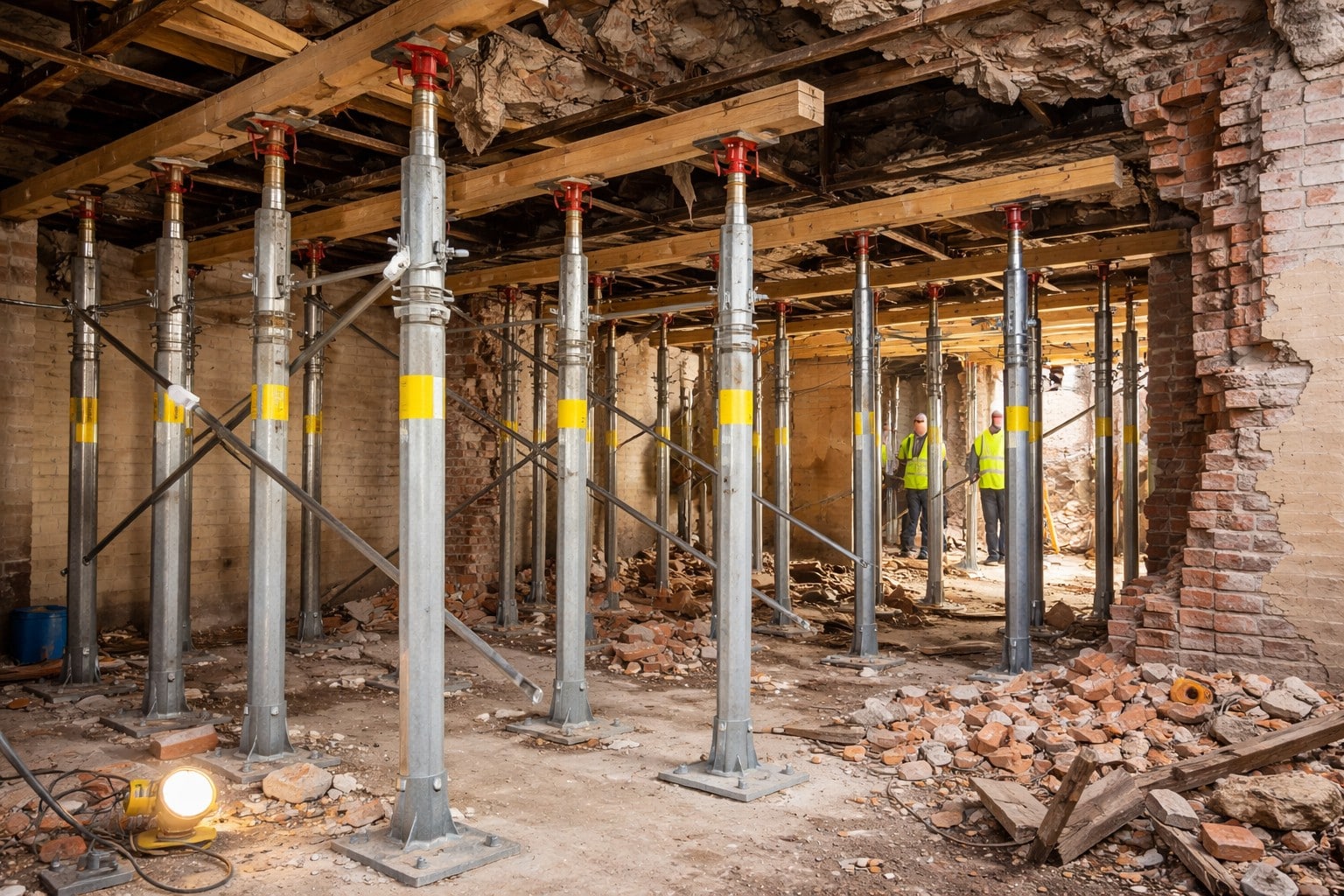
Foundation problems usually start small: a hairline crack along a basement wall, a door that sticks, a floor that slopes just enough to notice. But when a foundation actually fails, the situation changes fast. A bowing basement wall can collapse inward. A settling footer can drop several inches in a matter of days, pulling framing, plumbing, and wiring with it. A lateral blowout from saturated soil can push an entire wall off its footing. In each of these cases, the structure above the foundation is now sitting on something that can no longer hold it. Emergency structural shoring is a temporary support system that prevents the entire structure above the failure from collapsing.
Key Takeaways
- Foundation failure is not the same as foundation settling. Failure involves sudden or accelerating movement that compromises the structure’s ability to carry a load safely.
- Shoring must be placed based on where loads are actually transferring, not where they were designed to transfer. A failed foundation changes the load path through the entire building.
- The type of failure (vertical settlement, lateral wall collapse, or soil washout) determines which shoring approach is appropriate.
- Emergency shoring is always temporary. The permanent solution may include helical-pile underpinning, full foundation replacement with the house lifted off the old foundation, or a combination of both.
- A team that can handle shoring, lifting, and foundation work eliminates the gaps between contractors that slow recovery and increase cost.
What Is the Difference Between Foundation Settling and Foundation Failure?
Every structure settles. Soil compacts under weight, moisture levels change, and the building adjusts. Normal settling is uniform and gradual, producing hairline cracks that remain thin over time. Foundation failure is different. It involves movement that is sudden, accelerating, or differential (one part of the foundation moving at a different rate or in a different direction than the rest). The signs are more aggressive: horizontal cracks in basement walls wider than 1/8 inch, stair-step cracking through mortar joints that widens at one end, floors that slope noticeably in one direction, doors and windows that jam shut, or visible displacement where the foundation has shifted off its original position.
The distinction matters for shoring because settling and failure produce different structural conditions. A settling foundation still carries the load; it just carries it at a lower elevation. A failing foundation may no longer carry a load at all in the affected area, meaning the framing above it has already begun redistributing weight to adjacent sections that were not designed for it. Shoring a settling foundation is about preventing further movement. Shoring a failed foundation is about catching loads that have already shifted and preventing a chain reaction from reaching the rest of the structure.
“People call us when cracks they’ve been watching for months suddenly get worse overnight. That’s the transition from settling to failure. The soil has reached a tipping point, and now the movement is accelerating. Once that happens, the window for controlled intervention starts closing.” – Jason DeVooght
What Causes a Foundation to Fail Suddenly?
Most foundation failures have been building for years before they become visible. The sudden event is usually the final stage of a longer process. Understanding what triggered the failure helps determine how to shore up and what permanent repair will be needed.
Common causes behind sudden foundation failure:
- Lateral soil pressure on basement walls: Saturated soil expands against the outside of a basement wall, creating hydrostatic pressure that pushes the wall inward. If the wall was not reinforced for this load, or if a previous crack allowed water infiltration that weakened the concrete over time, the wall can bow and eventually collapse. This is the most common emergency shoring scenario for residential basements.
- Soil washout beneath footings: Drainage failures, broken pipes, or prolonged heavy rain can erode the soil directly beneath a footing, creating a void. When the footing loses its bearing surface, that section of the foundation drops. The structure above it follows, creating differential settlement that can crack walls, buckle floors, and tear apart utility connections.
- Expansive clay cycling: Clay soils swell when wet and shrink when dry. Repeated cycles over the years can create cumulative movement that eventually pushes a foundation past its tolerance. A single severe drought, followed by rapid rehydration, can trigger the final failure of a foundation that has been weakening for a decade.
- Poor original construction: Insufficient rebar, undersized footings, inadequate drainage, or foundations poured on improperly compacted fill soil can all create conditions where a foundation performs acceptably for years, then fails once conditions change. These deficiencies only become apparent when the foundation is under stress.
Each of these causes creates a different pattern of damage, and that pattern determines where shoring needs to go and how the permanent repair should be designed.
How Is Emergency Shoring Approached After a Foundation Failure?
The first priority is determining where the load path has shifted. In an intact building, loads travel in a predictable sequence: roof to rafters, rafters to bearing walls, bearing walls to sill plates, sill plates to foundation, foundation to soil. When the foundation fails, that chain breaks at the bottom, and the load has to go somewhere else. It typically moves laterally to adjacent foundation sections, which are now carrying more than they were designed for. If those sections are also compromised, the problem compounds.
How shoring addresses different failure types:
- For a collapsed or bowing basement wall, Raker shores are placed against the inside face of the wall to resist further inward movement. If the wall has already displaced significantly, diagonal bracing from the floor slab to the wall redistributes the lateral force. The key constraint is that the floor slab must be sound enough to serve as a bearing surface for the base of the shore. If the slab is cracked or heaving, cribbing or spread footings may be needed beneath the shore’s sole plate.
- For vertical settlement or footing failure: Vertical post shores are placed beneath the floor framing or bearing walls directly above the failed section, transferring the load down through the shore to a stable surface. If the basement floor slab is intact and the soil beneath it can still support the load, the shore can bear on the slab. If not, the shore may need to reach to undisturbed soil or to a temporary timber mat that spreads the load.
- For a full perimeter failure or multiple-wall compromise: This is the scenario where house lifting becomes part of the emergency response, not just the permanent fix. If the foundation has failed in enough areas that patching individual sections is no longer viable, the structure needs to be supported by a temporary steel beam and cribbing system, lifted off the old foundation entirely, and set on a new one.
“The mistake we see most often is someone shoring one wall without checking the rest of the perimeter. A single wall failure is rarely isolated. The same soil conditions, drainage problems, or age-related deterioration that caused one section to fail are usually affecting adjacent sections too. We check the full perimeter before we place the first shore.” – The team at DeVooght
When Does Foundation Failure Lead to House Lifting?
Emergency shoring buys time, but it does not rebuild the foundation. The permanent repair depends on how extensive the damage is and whether the existing foundation can be repaired in place or needs to be replaced entirely.
For isolated failures (one wall section or one footing), repairs such as carbon fiber reinforcement, push piers, or helical pile underpinning can often stabilize the foundation without lifting the house. For widespread or catastrophic failures, the most reliable solution is to lift the structure off the compromised foundation, demolish and remove it, and build a new one to current codes. This is particularly true for older homes built on unreinforced block, rubble stone, or shallow footings that cannot be retrofitted to modern standards.
“We’ve lifted homes off foundations that were 80 years old and falling apart from the inside. The house itself was perfectly sound. The framing, the roof, the mechanicals were all in good condition. The only thing wrong was the foundation. Lifting the house, removing the old foundation, and building a new one gave those homeowners a structure that will last another 80 years on a foundation designed for the soil conditions they actually have.” – David DeVooght
Helical piles are especially valuable in these situations because they bear load immediately upon installation, require no curing time, and reach stable soil strata well below the problem zone that caused the original failure. For homes in crumbling foundation territory, where the concrete or block itself has deteriorated beyond repair, helical piles paired with a new poured foundation provide a permanent, engineered solution.
How the DeVooght Team Can Help After a Foundation Failure
The DeVooght team has spent more than 55 years stabilizing, lifting, and re-founding structures across the East Coast and Great Lakes region. With 35+ international and regional awards from the International Association of Structural Movers, a fleet of 11 Unified Hydraulic Lifting Machines, and CHANCE-certified helical pile installation capability, we handle every phase, from emergency shoring to permanent foundation replacement, with a single crew and a single point of accountability.
If your foundation is showing signs of failure and you need to understand your stabilization and repair options, contact the DeVooght team at 844-203-9912.