Jacksonville, North Carolina, sits at the intersection of two realities: it is home to one of the largest Marine Corps installations in the country, and it sits squarely within some of the most active flood zones on the Atlantic coast. For military families stationed at Camp Lejeune who purchase property in Onslow County, the question of how to protect that investment from floodwater is not hypothetical. Helical piles offer a proven, engineering-backed foundation system that anchors homes deep into stable soil layers, keeping structures secure above rising water and shifting ground.
Why Is Jacksonville, NC Such a High-Risk Flood Area for Homeowners?
Jacksonville and Onslow County face a unique combination of flood threats. The city borders the New River, which flows southeast through the county before reaching the coast at Onslow Beach. Coastal storm surge, riverine flooding, and heavy rainfall all converge in this region, making it one of the more flood-exposed areas in North Carolina.
Hurricane Florence in September 2018 demonstrated just how severe that exposure can be. The storm delivered more than 30 inches of rain to parts of Onslow County, and a storm surge of 7.23 feet was recorded in Jacksonville. The Onslow County school district alone reported an estimated $125 million in damage. Neighborhoods that had never seen standing water before were completely inundated, and the flooding disrupted military operations, displaced families, and destroyed homes across the community.
The flood risk has only become more defined since then. New FEMA flood maps became effective on January 17, 2025, adding more than 3,500 buildings to A-zone flood areas in Onslow County. Base flood elevation changes of two to four feet were documented across multiple zones. Jacksonville itself saw one of the highest percentage-wise increases in high-hazard flood zone designations of any city in North Carolina when preliminary maps were first released.
“Military families buying near Camp Lejeune need to understand that flood maps are not static documents. The 2025 updates in Onslow County significantly expanded high-risk designations, and future revisions will likely incorporate sea level rise projections. That means the foundation decisions you make now should account for conditions 20 to 30 years down the road, not just today’s flood line.” – The Team at DeVooght
Flood Risk Factors Specific to Jacksonville and Onslow County
- Riverine flooding from the New River: The New River and its tributaries run through residential neighborhoods, and heavy rainfall events can push water levels well beyond normal banks, reaching homes that appear to be on dry ground during calm weather.
- Coastal storm surge: Onslow Bay funnels storm surge inland during hurricanes and nor’easters. During Florence, surge levels reached 3 to 8 feet along the bay, with even higher marks recorded upstream.
- Urban drainage limitations: Increased development in Jacksonville has added impervious surfaces like roads and parking lots, reducing the land’s ability to absorb rainfall and increasing the speed at which water collects in low-lying areas.
- Revised FEMA designations: The 2025 flood map update means thousands of homeowners who previously fell outside high-risk zones now face new insurance requirements, building code obligations, and elevation standards.
What Unique Flood Challenges Do Military Families Face When Buying Near Camp Lejeune?
Military families stationed at Camp Lejeune often face a compressed timeline when purchasing a home. A PCS (Permanent Change of Station) move typically gives families weeks, not months, to find and close on a property. That urgency can lead to purchasing homes without fully understanding the flood zone classification, the required elevation standards, or the long-term cost of inadequate foundation protection.
The financial stakes are significant. VA loans, which are used by the majority of military homeowners in Jacksonville, require flood insurance for any property located within a FEMA-designated Special Flood Hazard Area (SFHA). In North Carolina, the average annual NFIP flood insurance premium runs around $874 to $925, but properties in high-risk AE or VE zones can see premiums of $2,000 to $4,000 or more per year. Under FEMA’s Risk Rating 2.0 system, premiums are now calculated on a property-by-property basis, factoring in the home’s distance from water sources, elevation, building materials, and replacement cost.
How VA Loan Flood Requirements Affect Military Buyers in Jacksonville
| Requirement | Details for Military Buyers |
|---|---|
| Flood insurance mandate | Required for all VA-financed properties in a FEMA SFHA (A or V zones) |
| Appraisal standards | VA appraisers can deem a property ineligible if flooding risk is deemed excessive, regardless of SFHA status |
| Coastal Barrier exclusion | Homes in Coastal Barrier Resources System areas are not eligible for VA loans |
| Insurance cost impact | Annual NFIP premiums in NC average $874-$925; high-risk zones can exceed $4,000/year |
| Elevation documentation | An elevation certificate may be needed to verify compliance and can reduce insurance costs |
Beyond insurance, military families also face the reality that they may only live in the home for two to four years before receiving new orders. That short ownership window makes it tempting to skip or delay foundation improvements. But the cost of flood damage to a poorly protected home can wipe out equity quickly, and selling a home with known flood vulnerability or a non-compliant foundation becomes far more difficult.
“We’ve worked with dozens of military families around Camp Lejeune who purchased homes without realizing the foundation was not built to current flood standards. The good news is that helical piles can be installed under existing structures with minimal disruption, often within days. That kind of speed matters when you’re managing a PCS timeline and trying to protect your family’s biggest financial asset.” – The Team at DeVooght
What Are Helical Piles and How Do They Work in Flood-Prone Soil?
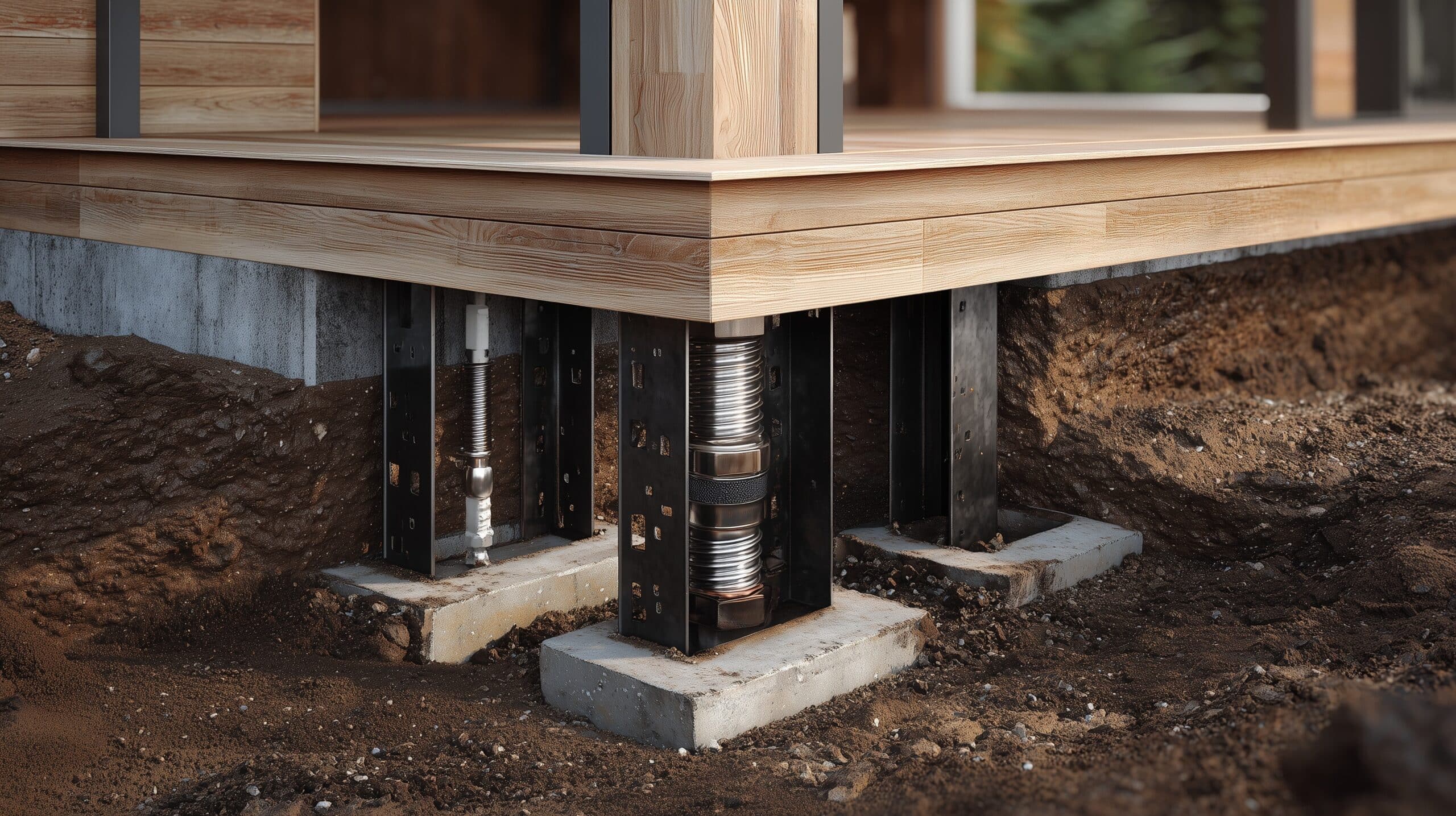
Helical piles are steel foundation shafts fitted with one or more helix-shaped plates (often called blades or flights) welded near the lower end. During installation, a hydraulic motor attached to standard construction equipment (such as a skid steer or mini-excavator) rotates the pile into the ground, much like turning a large screw. The helix plates pull the shaft downward through weak surface soil until it reaches stable, load-bearing ground. Once the pile reaches the target depth and torque reading, it can accept structural loads immediately with no curing time required.
This design makes helical piles particularly well-suited for flood-prone properties in Jacksonville and Onslow County, where the coastal soil profile often includes layers of sand, clay, and organic material near the surface. Traditional concrete foundations rest within these upper layers, which are the first to saturate, shift, and erode during flood events. Helical piles bypass those unstable zones entirely, transferring the home’s weight to deeper, denser strata that remain unaffected by surface water.
Key Components of a Helical Pile System
- Central steel shaft: Typically a round or square steel tube, hot-dip galvanized for corrosion resistance. Shaft diameter is selected based on the structural load requirements and soil conditions at the site.
- Helix plates: Screw-shaped bearing plates welded to the lead section. Plate size and number are engineered to match the specific soil type and load demands of the project.
- Extension shafts: Added to the lead section to reach deeper soil layers when surface conditions require it. In Jacksonville, installation depths can range from 15 to 55 feet depending on the geotechnical report.
- Pile cap or bracket: A steel plate or bracket mounted at the top of the pile that connects to the home’s structural beams, distributing the load from the building to the pile system below.
How Helical Piles Compare to Other Foundation Types in Flood Zones
| Foundation Type | Flood Suitability | Installation Time | Curing Required | Soil Versatility |
|---|---|---|---|---|
| Helical piles | Excellent; anchors below flood-affected layers | 1-3 days typical | None; immediate load capacity | High; effective in sand, clay, and mixed soils |
| Concrete footings | Poor in high-risk zones; prone to shifting and erosion | 3-7 days plus cure time | Yes; 7-28 days | Moderate; struggles in wet or unstable soil |
| Driven timber pilings | Good; reaches stable soil | 2-5 days | None | Moderate; vibration can affect nearby structures |
| Concrete piers | Good if deep enough | 3-7 days plus cure time | Yes; 7-28 days | Moderate |
One of the most practical advantages of helical piles in a flood zone setting is that they can be installed in the presence of standing water. Unlike concrete-based foundations, which cannot be poured or cured in wet conditions, helical piles are driven mechanically into the ground regardless of surface water levels. For a region like Jacksonville, where rainfall events can dump inches of water in hours, this characteristic alone can prevent costly project delays.
How Do Helical Piles Support Homes That Need to Meet Base Flood Elevation?
In Onslow County, any new construction or substantial improvement within a Special Flood Hazard Area must raise the lowest floor to or above the base flood elevation (BFE) established on the current FEMA flood maps. For existing homes that fall below that line, the options typically include filling the lot (which is expensive and can redirect water to neighboring properties), demolishing and rebuilding, or lifting the house to the required height and installing a new, compliant foundation system beneath it.
Helical piles play a direct role in that third option. When a home is lifted above the BFE, the raised structure needs a foundation capable of supporting its full weight at the new, higher elevation while also resisting the lateral forces that floodwaters, wind, and storm surge can produce. Helical piles provide exactly that type of support. Because each pile anchors deep into stable ground, the elevated home sits on a system that resists both vertical settlement and horizontal movement during storms.
In velocity zones (VE zones), where wave action adds significant lateral force to flood events, the depth and anchoring strength of helical piles become even more important. Traditional shallow foundations can be undermined by scour (the erosion of soil around the base of a structure caused by moving water). Helical piles, seated well below the scour-affected layer, remain secure while the surface soil above shifts.
“Lifting a home above the base flood elevation is only half the solution. The other half is what holds that home in place once it’s up there. We’ve installed helical pile systems under homes along the North Carolina coast that have weathered multiple storm events without measurable settlement. The piles do their job quietly, year after year, which is exactly what a military family needs from a foundation they might not be around to monitor during deployment.” – The Team at DeVooght
Steps in a Typical Helical Pile Installation for an Elevated Home
- Geotechnical assessment: A soil boring or test pit determines the depth to stable bearing soil and identifies any problematic layers (such as peat, loose sand, or high-plasticity clay) that the piles will need to pass through.
- Engineering design: A structural engineer specifies the number of piles, their diameter, helix plate size, spacing, and required installation torque based on the home’s weight and the soil report.
- Home lifting: If the home is already built, a professional house lifting company raises the structure on temporary cribbing towers to the target elevation.
- Pile installation: Each helical pile is rotated into the ground using hydraulic equipment. Installation torque is monitored in real time to confirm the pile has reached the required bearing capacity.
- Connection and load transfer: Pile caps or brackets are attached to the home’s structural beams. The building’s weight is transferred from the temporary cribbing to the permanent helical pile system.
- Finishing and compliance: Flood vents, breakaway walls, or other required features are installed per local code. An elevation certificate is obtained to document the new height for insurance and permitting purposes.
What Financial Benefits Do Helical Piles Offer Military Homeowners in Flood Zones?
The upfront cost of helical pile installation is a serious consideration, but the financial math often works in favor of the investment, particularly for properties in high-risk flood zones. The national cost range for helical piers runs from roughly $1,500 to $2,700 per pile for residential applications, with most homes requiring between 5 and 15 piles depending on size and load requirements. Total project costs for a full helical pile foundation typically fall between $15,000 and $40,000, though the exact figure depends on soil conditions, home weight, installation depth, and local labor rates.
Those numbers need to be weighed against the costs of not upgrading the foundation. FEMA data shows that just one inch of floodwater inside a home can cause $25,000 or more in damage. A home that floods repeatedly without adequate protection can lose tens of thousands in equity and become increasingly difficult to sell or insure. For military families who may need to sell within a few years of purchasing, a home with a compliant, elevated foundation on helical piles is far more marketable than one sitting below the BFE on an aging concrete slab.
Long-Term Financial Impact of Helical Pile Foundation Upgrades in Flood Zones
| Financial Factor | Without Helical Piles | With Helical Piles + Elevation |
|---|---|---|
| Annual flood insurance premium (high-risk zone) | $2,000-$4,000+ | $500-$1,200 (after elevation above BFE) |
| Flood damage cost per event (moderate flooding) | $25,000-$75,000+ | Minimal if elevated above BFE |
| Resale value impact | Reduced; buyers wary of flood risk | Preserved or increased; compliant foundation adds confidence |
| Foundation maintenance over 10 years | $5,000-$15,000 (crack repair, settling correction) | Minimal; annual visual inspection only |
| Eligibility for FEMA mitigation grants | May qualify for elevation grants | Completed; potentially eligible for reimbursement |
The insurance premium reduction alone can offset a significant portion of the installation cost over time. A homeowner paying $3,500 per year in flood insurance who reduces their premium to $900 after elevation saves $2,600 annually. Over a five-year period, that adds up to $13,000 in savings, which covers a substantial share of the pile installation cost. For military homeowners using a VA loan, those lower insurance costs also improve monthly cash flow, an important factor when managing a household on military pay scales.
Onslow County and Jacksonville both participate in FEMA’s Community Rating System (CRS) at a Class 8 level, which provides a 5 to 10 percent discount on flood insurance premiums for properties within participating jurisdictions. Homeowners who take additional mitigation steps, such as installing helical piles and elevating above the BFE, can combine those CRS discounts with the rate reductions that come from improved elevation documentation.
How Should Military Families Choose the Right Foundation Contractor in Jacksonville?
Selecting a contractor for helical pile installation in a flood zone requires more scrutiny than a standard foundation project. The soil conditions in Onslow County vary significantly from one neighborhood to the next, and the consequences of an improperly installed pile system in a flood-prone area can be severe. Military families should prioritize contractors who bring specific qualifications and regional experience to the table.
What to Look for When Selecting a Helical Pile Contractor
- Certified installer status: Look for contractors who hold CHANCE certification or equivalent manufacturer-backed credentials. These certifications confirm that the installer has been trained on proper torque monitoring, pile selection, and quality control protocols.
- Geotechnical coordination: A qualified contractor will either conduct or coordinate a geotechnical investigation before quoting the project. Avoid any contractor willing to estimate pile depth and count without reviewing soil data.
- Flood zone experience: The contractor should have documented experience installing piles in FEMA-designated flood zones, particularly AE and VE zones. Ask for references from projects in Onslow County or similar coastal North Carolina environments.
- Structural engineering partnerships: The best contractors work closely with licensed structural engineers who design the pile layout and sign off on the completed installation. This documentation is often required for permitting and insurance purposes.
- Insurance and bonding: Confirm the contractor carries adequate liability insurance and is bonded. For projects involving house lifting, a separate insurance policy may be needed to cover the structure during the elevation process.
Military families should also ask about project timelines. One of the practical advantages of helical piles is speed of installation. Most residential projects can be completed in one to three days of active pile driving, with the full project (including home lifting, pile installation, and reconnection) typically finished within two to four weeks. For families working around deployment schedules or PCS deadlines, that compressed timeline can be the difference between completing the project and leaving it unfinished.
“We’ve built our practice around understanding the specific soil conditions and flood risks in coastal North Carolina. When we work with a family near Camp Lejeune, we’re not applying a generic formula. We’re reviewing the geotechnical data for that specific lot, designing a pile layout that accounts for the BFE changes in the 2025 flood maps, and coordinating with the local permitting office to make sure every detail is documented. That level of attention protects the homeowner during the next storm and the next appraisal.” – The Team at DeVooght
What Maintenance Do Helical Piles Require After Installation?
One of the most appealing qualities of helical piles for military families is their low maintenance profile. Because the piles are seated deep underground in stable soil, they are not exposed to the freeze-thaw cycles, surface erosion, or standing water that deteriorate traditional concrete foundations over time. The galvanized steel construction provides corrosion resistance, and properly installed piles rarely require adjustment after the initial load transfer.
That said, homeowners should follow a basic inspection routine to catch any issues early.
Recommended Post-Installation Inspection Schedule
- Annual visual check: Inspect the pile caps, brackets, and any above-grade hardware for signs of corrosion, loosening, or unusual movement. This takes less than an hour for most homes and does not require professional equipment.
- Post-storm inspection: After any significant weather event (particularly hurricanes, tropical storms, or major rainfall), walk the perimeter and check for visible changes in the pile connections, grade around the foundation, or water erosion patterns near the base of the piles.
- Professional evaluation every 3-5 years: Have a structural engineer or certified installer perform a more detailed review, including checking torque readings and verifying that no lateral movement has occurred. This is particularly important for homes in VE zones where wave action adds stress.
- Record-keeping for resale: Maintain a file with the original geotechnical report, engineering design, installation records (including torque logs), elevation certificate, and any inspection reports. This documentation simplifies the appraisal and sale process when you receive new orders.
For military families who may deploy or PCS before a scheduled inspection, consider designating a trusted neighbor or property manager to conduct the annual visual check. Many helical pile installers also offer post-installation service agreements that include periodic inspections, which can provide peace of mind during extended absences.
How Do Onslow County’s 2025 Flood Map Changes Affect Foundation Decisions?
The January 2025 flood map update in Onslow County represents one of the most significant shifts in flood risk designation the area has seen. More than 3,500 structures were added to A-zone flood areas, and base flood elevations changed by two to four feet in multiple zones. Revised preliminary maps released in 2024 incorporated newer data, including LiDAR (Light Detection and Ranging) technology, which produces more precise elevation models than previous methods.
For homeowners, these changes have immediate and practical consequences. A property that was previously in a moderate-risk or low-risk zone may now fall within a Special Flood Hazard Area, triggering mandatory flood insurance requirements for anyone with a federally backed mortgage (including VA loans). For properties already in an SFHA, an increase in the base flood elevation means the home may no longer meet the minimum elevation standard, which can increase insurance premiums and potentially require foundation upgrades to remain compliant.
Ryan King, Jacksonville’s director of planning and inspections, has noted that the next round of flood map revisions is expected to incorporate sea level rise projections, which would add further elevation requirements on top of the 2025 baseline. That reality makes it worth considering a foundation system, like helical piles, that can accommodate future height adjustments. Because helical piles can support additional load and can be augmented with supplemental piles if needed, they offer a future-ready foundation that adapts as conditions change.
Summary of 2025 Onslow County Flood Map Changes
| Change Category | Impact |
|---|---|
| New A-zone designations | 3,500+ buildings added to high-risk flood areas |
| Base flood elevation shifts | 2-4 foot increases in multiple zones |
| Data source upgrade | LiDAR technology replaced older elevation models |
| VE zone adjustments | Some North Topsail Beach buildings lost VE designation, reducing premiums |
| Future projections | Next revision expected to incorporate sea level rise data |
| Appeals period | 90-day window for property owners to challenge revised designations |
Military families who recently purchased in Jacksonville should check whether their property was affected by the 2025 update. Onslow County’s GIS tool (GoMaps) includes layers showing both historic and current flood maps, and the North Carolina Flood Risk Information System (fris.nc.gov) provides property-level flood zone data. If your home’s designation changed, contact your insurance agent and a structural lifting and foundation specialist to understand your options before the next storm season.
Protecting Your Investment Starts Below the Surface
For military families in Jacksonville, NC, the right foundation is not just a construction detail. It is the single most important factor in determining whether your home survives the next flood event or becomes another statistic. Helical piles offer a proven, adaptable, and low-maintenance solution that meets current FEMA standards, reduces long-term insurance costs, and protects the equity you’ve built in a home you may only own for a few years.
The team at DeVooght has spent decades helping homeowners across North Carolina, South Carolina, New Jersey, and Wisconsin protect their properties through house lifting, structural relocation, and helical pile installation. We understand the specific soil conditions, flood risks, and permitting requirements in Onslow County, and we work with military families to complete projects on timelines that respect the realities of service life. If you need help with home elevation or foundation protection, reach out to the DeVooght team to discuss your options and get a site-specific assessment.