Your foundation carries every ounce of weight your home will ever hold. Choosing between helical piles and concrete footings will shape how that weight is distributed, how long the foundation lasts, and how much you spend over time. Both options can deliver solid structural support, but they perform very differently depending on your soil, your climate, your timeline, and your budget. This guide breaks down the real differences so you can make the right call for your project.
What Are Helical Piles and How Do They Work?
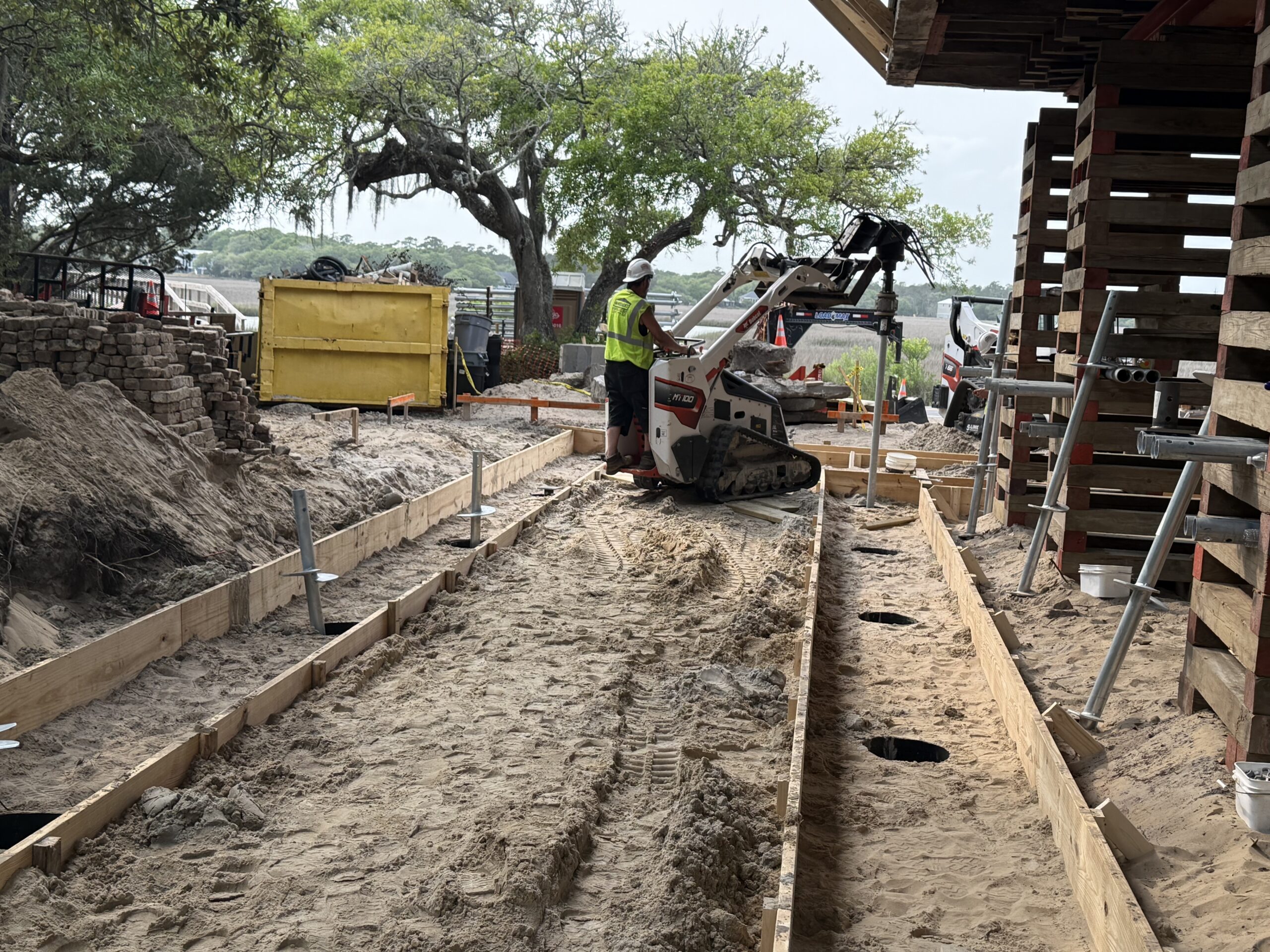
Helical piles are steel shafts fitted with one or more spiral-shaped bearing plates (called helix plates) welded near the bottom. Contractors install them by rotating the shaft into the ground using a hydraulic torque motor attached to an excavator or skid steer. As the pile advances through the soil, the helix plates pull it deeper, much like turning a screw into wood. The pile keeps advancing until it reaches a stable, load-bearing soil layer below the frost line.
What makes this system distinct is what happens during installation. The installing crew monitors torque readings in real time. These readings directly correlate to the pile’s load-bearing capacity, giving the crew and the helical pile foundation installation team verified data before the structure is ever placed on top. Once installed, helical piles can bear weight immediately with zero cure time. That means construction can continue the same day.
The technology dates back to the 1830s, when Irish engineer Alexander Mitchell developed screw piles for stabilizing lighthouses in shifting marine soils. Today, they’re used across residential, commercial, and industrial projects, from deck foundations and home additions to full house elevations in flood zones.
“We’ve installed helical piles across four states in conditions ranging from saturated coastal sand to dense inland clay. The real-time torque verification during installation gives us and the homeowner confidence that the foundation will perform exactly as engineered.” – The Team at DeVooght
What Are Concrete Footings and When Are They Used?
Concrete footings are reinforced concrete bases poured into excavated trenches below a home’s foundation walls. They spread wider than the walls above them, distributing the structure’s weight across a larger area of soil to prevent settling. Standard residential footings typically extend below the frost line, and workers reinforce the concrete with rebar before pouring.
The installation process follows a predictable sequence: excavation of the trench, placement of forms, laying of rebar, pouring of concrete, finishing, and then waiting for the concrete to cure. That cure period, usually a minimum of 7 days before any load is applied (with full strength reached at approximately 28 days), is one of the more significant differences between the two systems.
Concrete footings remain the most widely used residential foundation method in the United States. They work well for straightforward projects on stable, well-compacted soil with good drainage. Monolithic slab foundations (where the footing and slab are poured in a single step) are especially popular in warmer climates with shallow frost lines.
Common residential applications for concrete footings include:
- Slab-on-grade homes: Single-pour foundations used across temperate and warm climates where frost depth is shallow and the terrain is level.
- Stem wall foundations: A two-step system where footings are poured first, followed by short walls, then the slab, ideal for uneven terrain or mild frost zones.
- Garage and outbuilding slabs: Standalone pads that support lighter loads and simpler structures.
- Crawl space perimeters: Continuous footings poured around the home’s perimeter to support block or poured walls creating crawl space access below.
How Do Installation Speed and Weather Dependency Compare?
One of the sharpest contrasts between these two foundation systems is the installation timeline and how weather conditions affect it.
A typical residential helical pile foundation can be completed in a single day. Crews using a mini excavator or skid steer fitted with a hydraulic drive head can install a pile in minutes. There is no excavation, no formwork, no cure period. The pile is ready to accept load as soon as it reaches the required torque and depth. This means your project stays on schedule regardless of season. Helical piles go in during summer heat, winter cold, and even light rain without issue.
Concrete footings tell a different story. The process begins with excavation (often 3 to 4 feet deep or more depending on local frost line requirements), followed by form setting, rebar placement, the pour itself, and then the wait. Cold weather can delay pours entirely because concrete should not be placed when temperatures drop below 40°F without special precautions. Rain during or shortly after a pour can compromise the surface finish and structural integrity. Even under ideal conditions, a concrete footing project typically takes 3 to 7 days before the foundation is ready for the next phase.
Installation comparison between helical piles and concrete footings:
| Factor | Helical Piles | Concrete Footings |
|---|---|---|
| Typical installation time | 1 day (residential) | 3 to 7 days |
| Equipment needed | Mini excavator or skid steer with torque head | Excavator, concrete truck, forms, vibrator |
| Weather sensitivity | Minimal; installs year-round | High; rain and cold temperatures cause delays |
| Cure time before loading | None; immediate load capacity | 7+ days minimum; 28 days for full strength |
| Site disturbance | Minimal; no excavation or soil disposal | Significant; requires excavation and soil removal |
| Quality verification | Real-time torque monitoring during install | Post-pour inspections and testing |
For homeowners and contractors working on tight project timelines, this difference alone can shift the decision. A timeline reduction of 30% to 50% compared to concrete translates to lower labor costs and fewer scheduling complications, particularly during busy construction seasons.
Which Foundation Performs Better in Poor or Coastal Soil?
Soil conditions are often the deciding factor when choosing between these two systems. If you’re building on stable, well-compacted soil with minimal moisture issues, concrete footings can perform reliably for decades. A well-built concrete foundation can last 80 to 100 years or more under the right conditions.
The challenge arises when soil conditions are anything less than ideal. Sandy coastal soils, expansive clay, high water tables, marshy terrain, and fill dirt all present problems for concrete. Concrete footings sitting in unstable or saturated soil are prone to settling, cracking, and shifting over time, sometimes within just a few years of installation. Water infiltration can accelerate deterioration, and freeze-thaw cycles in northern climates can cause frost heave that lifts and cracks concrete foundations.
Helical piles bypass these problems by anchoring deep into stable load-bearing strata below the problematic surface layers. Whether you’re dealing with soft sand along the Carolina coast or clay-heavy soil inland, properly sized helix plates and shaft lengths allow the pile to reach firm ground. Because the pile transfers its load to these deeper layers, surface-level soil movement has far less impact on the foundation’s integrity.
This advantage is particularly important for house lifting services for flood prevention and coastal construction. Homes in flood zones and along eroding shorelines face constant soil pressure from tidal action, storm surge, and water saturation. Standard concrete footings installed in these environments often fail prematurely. Helical piles, with their galvanized steel construction and deep embedment, resist corrosion and remain stable even during flooding events.
“Along the coast, we regularly see concrete foundations that have settled or cracked within five to ten years because of soil erosion and water saturation. Helical piles anchored into firm strata below the sand give these homes the stability they need, and that’s why we recommend them for most coastal elevation projects.” – The Team at DeVooght
What Does Each Foundation System Cost?
Cost is usually the first question homeowners ask, and the answer depends on whether you’re looking at upfront material costs or total project costs over time.
Concrete footings are generally less expensive on a per-unit material basis. Standard residential footings cost approximately $5 to $18 per linear foot, with individual pad footings running $700 to $1,500 each installed. A full slab-on-grade foundation for a 2,000-square-foot home typically falls between $12,000 and $28,000 depending on thickness, reinforcement, and site preparation needs.
Helical piles carry a higher per-unit price tag. Most residential installations run $1,500 to $4,000 per pier installed, with the total project cost depending on how many piles the structure requires. A small deck project might need just 4 to 8 piers ($4,500 to $10,000), while a full home foundation could require 10 to 20 or more piles. For foundation repair and underpinning, most homeowners spend between $15,000 and $30,000.
Where the math gets more interesting is on the total cost side. Concrete footings require excavation, formwork, delivery of ready-mix concrete, finishing labor, and cure time before the next phase of construction begins. Weather delays can add days or weeks of carrying costs. Poor soil conditions may require additional fill, compaction, or even soil remediation before the pour. And if the concrete settles or cracks down the road, repair costs can range from $1,500 to $12,000 or more.
Cost comparison for a typical residential project:
| Cost Category | Helical Piles | Concrete Footings |
|---|---|---|
| Material cost per unit | $1,500 – $2,000 per pier | $5 – $18 per linear foot |
| Labor cost per unit | $500 – $2,000 per pier | $0.50 – $8 per linear foot |
| Excavation costs | Minimal to none | $1,000 – $5,000+ |
| Weather delay risk | Low | Moderate to high |
| Long-term repair likelihood | Low (150+ year lifespan in normal soil) | Moderate (cracking, settling possible within 10-20 years in poor soil) |
| Removal/reuse potential | Fully removable and recyclable | Costly demolition required |
Helical piles frequently become the more cost-effective option when you factor in reduced labor hours, eliminated excavation costs, zero weather delays, and lower long-term maintenance needs. This is especially true in challenging soil conditions, limited-access sites, and projects with accelerated timelines.
How Do Environmental Impacts Differ Between the Two Systems?
The environmental gap between helical piles and concrete footings is substantial and becoming increasingly relevant as building codes and buyer expectations shift toward greener construction.
Concrete production is one of the largest industrial sources of carbon dioxide globally. According to the World Economic Forum, global cement manufacturing accounts for roughly 8% of worldwide CO2 emissions, producing 1.6 billion metric tons of CO2 in 2022 alone. A typical residential home might need 100 to 300 tons of concrete for its foundation. Beyond production emissions, concrete requires heavy equipment for excavation and delivery, and any excess material must be disposed of, adding to the carbon footprint.
Helical piles use steel, which does carry its own production emissions. Steel manufacturing produces roughly 1.85 tons of CO2 per ton of steel. But the total weight of steel in a helical pile foundation is a fraction of what a comparable concrete foundation weighs. One of the largest helical pile foundations for utility pole bases, for example, weighs approximately 404 pounds, while a comparable concrete base could weigh over 10,000 pounds. That difference in material alone significantly reduces the carbon cost, and research from the helical pile industry suggests concrete foundations can produce 351% more CO2 emissions than an equivalent helical pile system.
Key environmental differences between helical piles and concrete footings:
- Recyclability: Helical piles are 100% recyclable and can even be removed and reused on another project. Concrete is permanent, difficult to remove, and typically ends up in landfills when demolished.
- Site disturbance: Helical pile installation displaces almost no soil and protects existing root systems, vegetation, and landscaping. Concrete footings require substantial excavation that damages the surrounding site.
- Water usage: Concrete mixing and curing require thousands of gallons of water per project. Helical piles need none.
- Noise and vibration: Helical pile installation is quiet and vibration-free, making it suitable for sensitive environments like wetlands, historic districts, and densely built neighborhoods. Concrete work involves loud machinery, vibrators, and heavy truck traffic.
For homeowners building near wetlands, waterways, or environmentally sensitive coastal areas, helical piles are often the only foundation option that meets environmental protection requirements while still delivering reliable structural support.
When Is Each Foundation the Better Choice?
Neither system wins in every situation. The right answer depends on your project’s specific conditions, and sometimes the best solution combines both.
Scenarios where helical piles are the stronger choice:
- Poor or unstable soil: Sandy coastal soil, expansive clay, high water tables, marshy ground, or fill dirt all favor helical piles because they bypass surface-level instability to reach firm bearing strata.
- Flood zone construction: Homes in FEMA-designated flood zones often need to be raised above base flood elevation. Helical piles provide the deep anchorage needed to support elevated structures against storm surge, tidal action, and soil erosion. This is particularly relevant for homeowners exploring house elevation to meet compliance requirements.
- Foundation repair and underpinning: When an existing foundation has settled or shifted, helical piles can be screwed in beneath the existing structure using small equipment, stabilizing or even lifting it back to level without extensive demolition.
- Limited-access sites: Tight lots, properties with mature landscaping, or homes in dense neighborhoods where concrete trucks cannot easily reach benefit from helical piles’ compact installation footprint.
- Accelerated timelines: Projects where delays carry significant financial cost (commercial builds, time-sensitive repairs, insurance-driven deadlines) benefit from same-day installation and immediate load capacity.
- Coastal and waterfront properties: Erosion-prone shorelines and marine environments demand corrosion-resistant, deeply anchored foundations. Helical piles for homeowners in these areas provide that reliability.
Scenarios where concrete footings are the better fit:
- Stable, well-compacted soil: When soil testing confirms strong bearing capacity near the surface, concrete footings deliver reliable support at a lower upfront cost.
- Simple, ground-level construction: Slab-on-grade homes in warm climates with flat terrain and minimal frost depth can use monolithic concrete slabs cost-effectively.
- Extremely heavy loads concentrated at grade: Some large commercial slabs or heavy industrial applications still favor mass concrete solutions, particularly where the soil is strong and the load is distributed uniformly.
- Budget-constrained projects in favorable conditions: When soil, weather, and timeline all cooperate, concrete footings can be the most economical path.
“The foundation is not a place to cut corners. We’ve seen homeowners save a few thousand dollars upfront with concrete in coastal zones, only to face $15,000 or $20,000 in repair costs a decade later when settling and cracking start. The right foundation choice up front saves far more in the long run.” – The Team at DeVooght
Can Helical Piles and Concrete Footings Work Together?
Yes, and in many cases, a hybrid approach produces the best results. Combining helical piles with poured concrete is a common strategy for larger residential and commercial builds where both deep anchorage and a solid grade-level surface are needed.
In a hybrid system, helical piles are installed first to provide deep, verified load-bearing support. Concrete grade beams or caps are then poured on top of the pile heads, creating a stable platform for the structure. This approach gives you the depth and stability of helical piles with the surface-level continuity of concrete, and it’s especially useful for full home foundations, pool installations, and building moving services where both the original and destination sites need reliable foundation systems.
For homes being relocated away from eroding shorelines, the destination foundation is often built as a hybrid system: helical piles anchored into stable ground with concrete tie beams connecting them. This gives the relocated home a modern, code-compliant foundation that will resist the same forces that threatened it in its original location.
How Does Foundation Choice Affect Property Value and Insurance?
Your foundation type can influence both your property’s resale value and your insurance premiums, particularly in flood-prone areas.
Homes in FEMA-designated flood zones that are raised above base flood elevation (BFE) on compliant foundation systems can qualify for significantly lower flood insurance premiums through the National Flood Insurance Program (NFIP). Helical piles anchored to proper depth and engineered for your specific flood zone classification meet the structural requirements for these insurance reductions. For coastal homeowners, this can mean substantial annual savings on flood insurance.
On the resale side, buyers in coastal and flood-prone markets increasingly look for homes with modern, code-compliant foundations. A home elevated on professionally installed helical piles signals to buyers and appraisers that the structure is built to withstand the environmental pressures of its location. This can support a stronger asking price compared to neighboring homes still sitting on aging concrete foundations at ground level.
Foundation impact on insurance and property value:
| Factor | Helical Pile Foundation (Elevated) | Concrete Footing at Grade |
|---|---|---|
| Flood insurance premium impact | Lower premiums when elevated above BFE | Higher premiums in flood zones at grade level |
| Buyer perception in flood-prone areas | Modern, resilient, and compliant | May be seen as outdated or at risk |
| Appraisal consideration | Foundation upgrade adds to assessed value | Standard; no added premium |
| Long-term maintenance risk | Low; verified load capacity and corrosion resistance | Higher in poor soil or coastal conditions |
“When we complete a house elevation project on helical piles, the homeowner walks away with a stronger foundation, lower insurance costs, and increased property value. That combination turns a structural investment into a financial one.” – The Team at DeVooght
What Should You Ask Before Choosing Your Foundation?
Before committing to either system, a few questions will help clarify the right path forward for your specific project.
Questions to address before selecting a foundation system:
- What do your soil test results show? A geotechnical report (typically $1,000 to $5,000) reveals the composition, bearing capacity, and moisture profile of your soil at various depths. This data is the single most important factor in choosing between helical piles and concrete footings.
- Is your property in a flood zone? If yes, FEMA requirements may dictate specific foundation types and minimum elevations. You can check your flood zone status through your local floodplain administrator or the FEMA Flood Map Service Center.
- What is your local frost line depth? Footings must extend below the frost line to prevent heave. In northern states, that can mean 3 to 4 feet of excavation for concrete, while helical piles naturally install well below this threshold.
- What is your project timeline? If you need to be on schedule for a specific move-in date, insurance deadline, or seasonal window, helical piles’ same-day installation capacity becomes a major advantage.
- Are you lifting or relocating an existing structure? Structural relocation and lifting services frequently pair with helical pile installation because the piles can be installed beneath a raised structure with minimal disruption.
- What is your long-term plan for the property? If you plan to hold the property for decades, investing in a foundation system with a 150+ year lifespan and verified load capacity may outweigh short-term savings on a concrete footing that could need repair in 10 to 20 years.
Moving Forward with the Right Foundation
The foundation you choose will affect your home’s stability, your insurance costs, your environmental footprint, and your long-term maintenance budget. Concrete footings remain a reliable, proven solution for projects on good soil with straightforward conditions. Helical piles offer clear advantages when soil is unstable, when the site is in a flood zone or coastal area, when timelines are tight, or when environmental impact matters.
The team at DeVooght brings decades of experience across New Jersey, North Carolina, South Carolina, and Wisconsin, providing helical pile installation, house lifting, and structural relocation services tailored to each project’s soil, structure, and goals. As a CHANCE certified helical pile installer, we deliver engineered foundation solutions backed by real-time torque verification and deep expertise in coastal and flood-prone construction.
If you’re weighing foundation options for a new build, a home elevation, or a foundation repair project, contact the DeVooght team to talk through your site conditions and get a professional recommendation. We’ll help you build on solid ground.