
Choosing the right deep foundation system can save you thousands of dollars and years of structural headaches. If you are building a new home in a flood zone, lifting a house above base flood elevation, or repairing a settling foundation, you will likely encounter two leading options: helical piles and driven piles. Both transfer structural loads past weak surface soils to stable ground below, yet they differ in design, installation method, cost, and performance. This guide breaks down each system so you can make a confident, informed decision for your project.
What Are Helical Piles and How Do They Work?
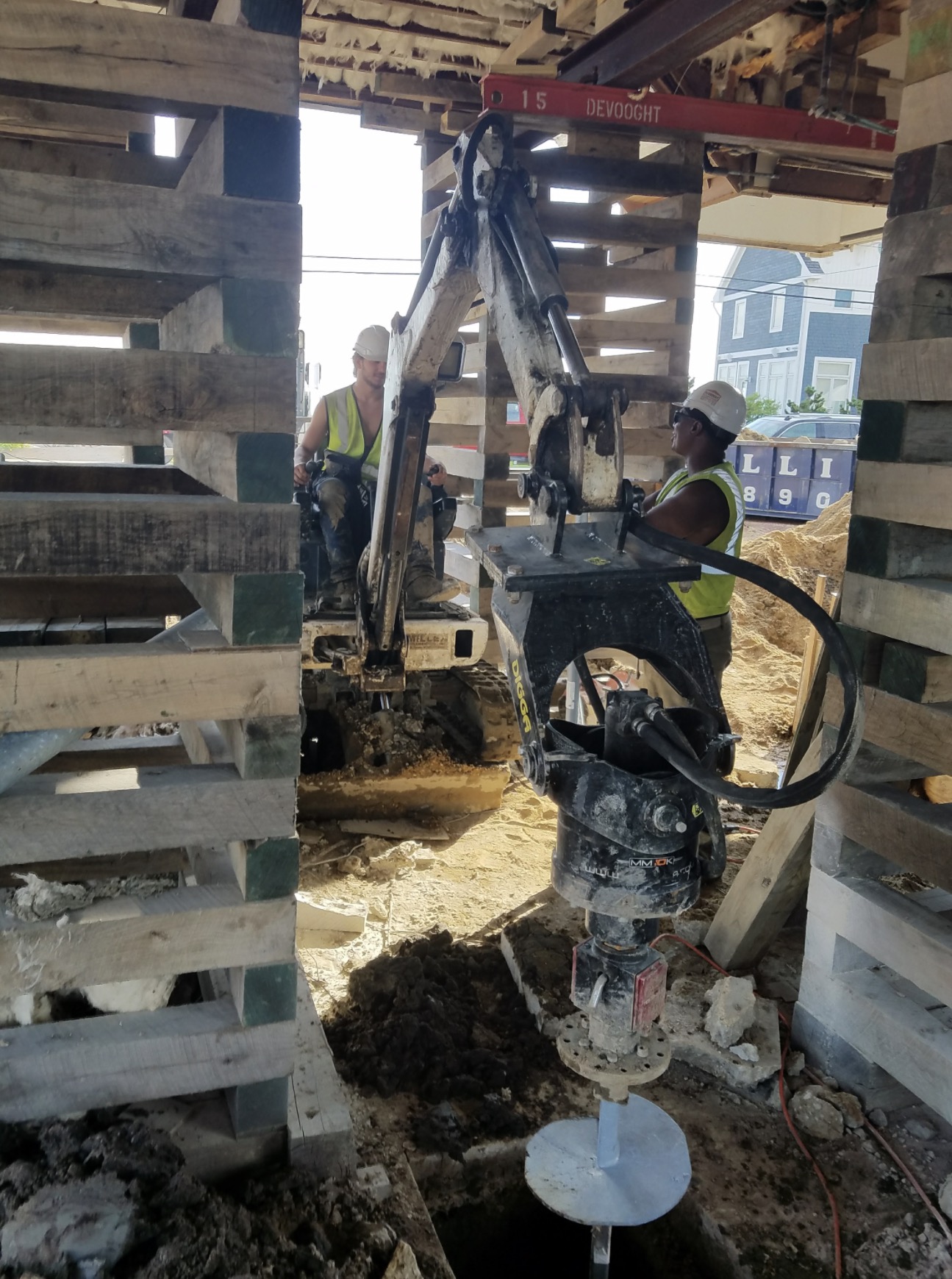
Helical piles are steel shafts fitted with one or more spiral-shaped plates (called helix blades) near the tip. A hydraulic drive head, typically mounted on a compact excavator or skid-steer loader, rotates the pile into the ground much like a large screw. As each helix plate advances through the soil, it displaces material and anchors into progressively denser strata. The torque required during installation correlates directly to the pile’s load-bearing capacity, giving crews real-time verification that the pile has reached competent ground.
Shaft diameters for residential and light commercial projects generally range from 2-7/8 inches to 8 inches. Helix plate sizes vary from 8 inches to 14 inches depending on soil type and load requirements. Working loads for standard residential helical piles fall between 25 and 100 kips (a kip equals 1,000 pounds), while larger-diameter pipe-shaft configurations used in commercial work can support considerably more. The modular design allows installers to bolt on extension sections, reaching depths from a few feet to 60 feet or more until the target soil layer is reached.
“We have installed helical pile foundations on everything from 30-ton bungalows to 160-ton waterfront homes. The ability to verify capacity in real time through torque readings gives both our crew and the homeowner confidence that the foundation will perform exactly as engineered.” – The Team at DeVooght
The updated ASCE 24-24 flood-resistant design standard now includes specific provisions for helical piles in flood zone construction, reflecting their growing role in coastal and flood-prone applications. For homeowners considering a house lifting project, helical piles pair well with elevation work because they can be installed around and beneath an existing structure without requiring large open excavations.
What Are Driven Piles and How Do They Differ?
Driven piles are prefabricated structural elements that are hammered or vibrated into the ground using specialized heavy equipment. The most common types include steel H-piles, steel pipe piles, precast concrete piles, and timber piles. A pile driver uses either an impact hammer (powered by diesel or hydraulic systems) or a vibratory hammer to force each pile downward until it meets a predetermined resistance or reaches a target depth, a condition called “refusal.”
The driving process displaces and compacts the surrounding soil, which can actually increase the frictional resistance along the pile shaft. This characteristic makes driven piles well suited for sites where soil compaction benefits load-bearing performance. Precast concrete driven piles can reach depths of 100 feet or more, and steel H-piles can be spliced to go even deeper. Load capacities for driven piles are typically higher per element than standard residential helical piles, with heavy-duty steel pipe piles supporting upward of 200 tons in commercial and infrastructure applications.
Where driven piles fall short is in their installation impact. The hammering process generates significant noise and ground vibration that can disturb neighboring structures and is often prohibited or restricted in residential neighborhoods, near historic buildings, and in sensitive environmental areas. The equipment footprint is also larger, requiring cranes and specialized rigs that need substantial site access and engineered work pads.
Key Structural Differences Between Helical and Driven Piles
| Feature | Helical Piles | Driven Piles |
|---|---|---|
| Installation Method | Rotated (screwed) into ground via hydraulic torque motor | Hammered or vibrated using impact/vibratory driver |
| Common Materials | Galvanized steel shaft with welded helix plates | Steel H-beams, steel pipe, precast concrete, timber |
| Typical Residential Load Range | 25 to 100+ kips per pile | 40 to 200+ kips per pile |
| Installation Depth | 10 to 60+ feet (modular extensions) | 15 to 100+ feet (spliced sections) |
| Noise During Installation | Minimal (comparable to standard excavator operation) | High (impact hammering or vibratory shaking) |
| Ground Vibration | Negligible | Significant (can affect nearby structures) |
| Capacity Verification | Real-time torque monitoring during install | Blow count per foot during driving; load testing after |
| Soil Displacement | Minimal (non-displacement pile) | Displaces and compacts surrounding soil |
Which Foundation Performs Better in Different Soil Conditions?
Soil type is one of the biggest factors in choosing between helical and driven piles. Neither system is universally superior; the right choice depends on what lies beneath your property.
Helical piles excel in sandy, silty, and soft clay soils that are common along the Atlantic and Gulf coasts. The helix plates function as end-bearing anchors, transferring loads directly to the stable stratum that each plate contacts. Because the pile is screwed into position rather than hammered, it does not disturb or liquefy saturated sandy soils the way an impact-driven pile can. This makes helical piles a preferred option in areas with high water tables, such as coastal North Carolina, South Carolina, and New Jersey, where helical pile foundation installation has become standard practice for both new builds and retrofit projects.
Driven piles perform best in granular soils and dense sand where the driving process compacts the material around the pile, creating additional friction-based support. They are also effective when a project requires reaching very deep bearing layers (50+ feet) or when the structure demands extremely high axial loads. Large commercial and infrastructure projects, such as bridges and industrial facilities, still rely heavily on driven piles because of their raw load capacity and proven long-term performance under sustained heavy use.
Soil Compatibility Comparison
| Soil Type | Helical Pile Suitability | Driven Pile Suitability |
|---|---|---|
| Loose/medium sand | Excellent; helix plates anchor in denser layers below | Good; driving compacts sand for added friction |
| Soft to medium clay | Very good; multiple helix plates distribute load | Good; may require pre-drilling in stiff layers |
| High water table | Excellent; no curing time, no dewatering needed | Workable, but driving in saturated soil can be challenging |
| Dense gravel/cobbles | Difficult; helix plates can be damaged by large stones | Better; impact force can push through coarse material |
| Expansive clay | Very good; anchors below the active zone | Good; needs to penetrate past the active zone |
| Fill or mixed soils | Good; screws past unreliable fill to native soil | Fair; unpredictable resistance during driving |
“Soil is the deciding factor in nearly every foundation conversation we have. Along the Carolina coast, we see sandy soils with water tables at 2 to 4 feet. Helical piles handle those conditions well because we can screw right through the saturated zone and anchor into the denser sand below without disturbing the ground around the home.” – The Team at DeVooght
How Does Installation Time and Equipment Compare?
One of the most practical differences between these two systems is how they go into the ground and how long that process takes.
Helical pile installation uses relatively compact equipment. A standard mini excavator (8 to 20 tons) fitted with a hydraulic drive head is all most residential projects require. This small footprint means crews can work in tight residential lots, between existing structures, and in landscaped yards without tearing up the entire property. A single helical pile can be installed in 15 to 45 minutes depending on depth and soil resistance. A typical residential project of 20 to 40 piles can be completed in one to three days. There is no curing time; the pile is ready to bear load immediately after installation.
Driven pile installation requires larger, heavier equipment. Impact pile drivers need a crane for support, and vibratory hammers need their own power packs and rigging. Mobilizing this equipment to a residential site adds both time and cost. The driving process itself is fast on a per-pile basis (minutes per pile in favorable conditions), but the setup, mobilization, and demobilization time is considerably greater. Residential projects using driven piles may take several days to a week when accounting for equipment staging and limited working hours due to noise restrictions.
Practical installation differences worth knowing:
- Site access requirements: Helical piles need only a compact excavator that can fit through a standard gate opening. Driven piles need crane access and a stable pad for heavy equipment, which may require grading or temporary roads.
- Noise and neighbor impact: Helical installation is quiet enough for suburban neighborhoods with no special noise permits. Driven pile work typically requires local noise permits and may be restricted to specific daytime hours.
- Weather sensitivity: Helical piles can be installed in rain, cold, and even standing water conditions. Driven piles can also be installed in poor weather, but wet or muddy sites create challenges for the heavy crane equipment.
- Immediate load bearing: Helical piles accept load right away. Concrete driven piles may need time for the surrounding soil to reconsolidate (called “setup time”) before reaching full capacity.
For structural relocation and lifting services, the compact installation profile of helical piles is a significant advantage. When a home is already elevated on temporary cribbing, crews can install helical piles directly beneath the structure with minimal clearance, something that would be nearly impossible with a full-size pile driving rig.
What Does Each System Cost for a Residential Project?
Cost is where many homeowners start their research, and it is also where the comparison gets nuanced. Both material prices and total installed costs vary widely based on location, soil conditions, depth to bearing stratum, and project scope.
Helical piles for residential applications typically cost $30 to $75 per linear foot for material alone, with installed costs (including labor, equipment, and engineering) ranging from $1,500 to $3,500 per pile for a standard 20-foot installation. Regional pricing varies; the South and Southeast tend to be on the lower end, while the Northeast and Mid-Atlantic markets run higher. For a typical home requiring 20 to 40 piles, total foundation costs may range from $30,000 to $100,000 depending on the number of piles, depth, and site conditions.
Driven piles for residential projects typically cost $50 to $150 per linear foot installed. Steel H-piles and pipe piles sit at the upper end of that range, while precast concrete piles and timber piles are more affordable per foot. Mobilization of the driving equipment alone can add $5,000 to $15,000 to a residential job. Total project costs for a residential driven pile foundation often land between $40,000 and $120,000+, though simple timber pile jobs in favorable conditions can come in lower.
Residential Foundation Cost Comparison
| Cost Factor | Helical Piles | Driven Piles |
|---|---|---|
| Material cost per linear foot | $30 – $75 | $50 – $150 |
| Installed cost per pile (20 ft depth) | $1,500 – $3,500 | $2,000 – $5,000+ |
| Equipment mobilization | $1,000 – $3,000 | $5,000 – $15,000 |
| Typical project (30 piles, 20 ft) | $45,000 – $105,000 | $65,000 – $165,000 |
| Site restoration after install | Minimal (low site disturbance) | Moderate to high (heavy equipment damage) |
Keep in mind that upfront price is only part of the financial picture. Helical piles produce no spoils (excavated soil) to haul away, require less site restoration after installation, and their faster timeline reduces labor hours. Driven piles may require soil removal, site regrading, and potentially vibration monitoring for nearby structures, all of which add to the final bill. For homeowners exploring financing options, understanding total project cost (not just per-pile cost) is the better way to budget.
“When we price a house lifting and re-foundation project, we look at total cost of ownership. The pile cost is one line item. Equipment access, site prep, cleanup, timeline, and the impact on the homeowner’s daily life all factor into our recommendations. In most residential scenarios along the coast, helical piles come in at a lower total project cost.” – The Team at DeVooght
Why Are Helical Piles Gaining Ground in Flood Zones and Coastal Areas?
Coastal and flood-prone communities from the Outer Banks to the Jersey Shore are seeing a steady shift toward helical pile foundations for both new construction and existing home elevation projects. Several factors are driving this trend.
Reasons helical piles are well suited for flood zone and coastal construction:
- No curing delays in wet conditions: In areas with high water tables or standing water, concrete foundations and concrete driven piles face curing complications. Helical steel piles bypass this entirely because no concrete is needed at the pile itself. The pile is load-ready the moment it reaches target torque.
- Reduced erosion risk during installation: Because helical piles displace very little soil, they do not create the spoils piles or open excavations that can accelerate erosion on coastal lots. This matters in communities like Oak Island and the Outer Banks, where erosion is already a serious concern.
- Compliance with updated flood codes: The ASCE 24-24 standard now directly addresses helical pile use in flood-resistant design. This formal recognition makes it easier for engineers and builders to specify helical piles on code-compliant projects in Special Flood Hazard Areas.
- Corrosion protection for saltwater environments: Modern helical piles are manufactured with galvanized steel or zinc coatings rated for a service life of 75+ years in most soils. For highly corrosive coastal soils, additional sacrificial anodes or epoxy coatings can extend that lifespan further.
- Compatibility with house lifting: When a professional house lifting company raises a home to meet FEMA base flood elevation requirements, the new permanent foundation often uses helical piles because they can be threaded in beneath the raised structure without heavy crane access.
The U.S. foundation repair services market was valued at roughly $667.8 million in 2024, and demand for pier and column solutions in flood-prone areas continues to grow as FEMA revises flood maps and insurance requirements tighten. Homeowners in coastal North Carolina, South Carolina, New Jersey, and Wisconsin are increasingly weighing foundation options as part of broader flood mitigation strategies.
When Is a Driven Pile the Better Choice?
Driven piles remain the standard for many large-scale and specialty applications. Understanding when they outperform helical piles prevents homeowners and builders from defaulting to one option without considering the full picture.
Situations that favor driven piles over helical piles:
- Very heavy structural loads: Multi-story commercial buildings, bridges, and industrial facilities often generate loads that exceed the capacity of standard helical pile sizes. Large-diameter steel pipe piles or H-piles driven to great depths can handle axial loads that would require an impractical number of helical piles.
- Dense or rocky subsurface layers: If the soil profile includes dense gravel, cobbles, or shallow bedrock, the helix plates on a helical pile can be damaged during rotation. Driven piles, with their blunt or pointed tips, can push through coarse material more effectively.
- Very deep bearing layers: When competent soil is more than 60 to 80 feet below the surface, driven piles (particularly steel H-piles) can be continuously spliced and driven to extreme depths. Helical piles can reach similar depths in theory, but the accumulated torque at great depths can exceed the shaft’s torsional strength rating.
- Projects with soil compaction benefits: In loose granular soils, the driving process itself densifies the surrounding ground. This added compaction increases the pile’s frictional capacity, something that does not occur with helical installation.
- Large open sites with no vibration restrictions: Warehouses, industrial parks, and rural commercial builds where noise and vibration are not concerns can take advantage of driven piles’ fast per-pile installation rates and proven heavy-load performance.
Most residential and light commercial projects in coastal and suburban areas will find that helical piles meet or exceed their needs. Driven piles come into their own when loads are extreme, depths are extraordinary, or subsurface conditions include obstructions that would damage helix plates. A qualified geotechnical investigation, including soil borings and Standard Penetration Testing (SPT), is the first step in determining which system fits your project.
What Should You Consider for a House Lifting or Elevation Project?
If your project involves raising an existing home to meet flood plain elevation requirements, the foundation system you choose becomes even more consequential. The home must be supported on temporary cribbing while the old foundation is removed and the new one is built beneath it. The new piles must be installed within the footprint of the building, often with limited overhead clearance and tight lateral access.
Helical piles are the dominant choice for house lifting projects for several practical reasons. The compact installation equipment can operate directly beneath a raised structure. No heavy impact hammering occurs, which means the temporarily supported home is not subjected to vibration that could crack finishes or shift the cribbing. Each pile’s capacity is confirmed in real time through torque readings, and the piles bear load immediately, allowing the home to be lowered onto the new foundation without waiting for concrete to cure.
Driven piles can work for elevation projects on open sites where the home has been moved entirely off its footprint (a full structural relocation). In these cases, the driving equipment can access the foundation area freely. For projects where the home stays on-site and is lifted vertically, the noise, vibration, and equipment size of driven pile installation make it far less practical.
Foundation considerations specific to house lifting projects:
- Access beneath the raised structure: Helical pile equipment fits in low-clearance spaces. Pile drivers do not.
- Vibration sensitivity: A home on temporary supports is more vulnerable to vibration-induced shifting. Helical piles produce no vibration during installation.
- Immediate load transfer: The faster you can lower a raised home onto its permanent foundation, the less time it spends on temporary supports. Helical piles allow same-day load bearing.
- Compatibility with new foundation walls: Helical piles connect to grade beams or pile caps that support new foundation walls or open-piling configurations, both of which are common in flood-compliant home elevation designs.
“Nearly every home elevation we perform today uses helical piles as the permanent foundation. The combination of torque-verified capacity, zero vibration, and fast installation lets us get homeowners back into their raised homes weeks sooner than alternatives.” – The Team at DeVooght
How Do Longevity and Maintenance Compare Over Time?
A foundation is a long-term investment, so it is worth looking past the installation phase to understand how each system performs over decades.
Helical piles made from galvanized steel have documented service lives exceeding 75 years in typical soils. Galvanization adds a sacrificial zinc coating that corrodes slowly in place of the structural steel beneath it. In highly acidic or saline soils, engineers may specify additional corrosion protection such as epoxy coatings, sacrificial anodes, or increased wall thickness. The Brighton Palace Pier in the United Kingdom, for example, has been supported on helical piles since the 1890s, proving that properly specified helical foundations can last well over a century.
Driven piles also offer strong longevity. Steel H-piles and pipe piles share similar corrosion considerations as helical piles. Precast concrete piles resist corrosion naturally but can be susceptible to sulfate attack in certain soil chemistries. Timber piles, the most affordable driven option, have shorter service lives (typically 30 to 50 years depending on treatment and soil moisture) and are vulnerable to marine borers in saltwater environments.
Longevity factors for each pile type:
- Galvanized helical piles: 75+ year expected service life in most residential soils. Zinc coating thickness is the primary variable. No routine maintenance needed below grade.
- Steel driven piles (H-piles, pipe): 75+ year expected service life when properly coated or cathodically protected. Subject to same corrosion factors as helical steel piles.
- Precast concrete driven piles: 75 to 100+ year expected service life. Resistant to most soil-based corrosion. Vulnerable to sulfate-rich soils and seismic lateral movement.
- Timber driven piles: 30 to 50 years with proper treatment. Not recommended for marine environments without specialized treatment.
From a maintenance standpoint, both helical and steel driven piles require no routine below-grade maintenance once properly installed. The above-grade connections (pile caps, brackets, and grade beams) should be inspected periodically, especially after major storm events or seismic activity. Homeowners with elevated homes should include foundation connection inspection as part of their regular property upkeep.
How Does Environmental Impact Factor Into the Decision?
Sustainability considerations are becoming more relevant to homeowners and builders, and foundation choice does carry environmental implications.
Helical piles have a smaller environmental footprint for several reasons. They produce virtually no spoils (excavated soil) during installation, meaning no truckloads of dirt need to be hauled off-site. The installation equipment is smaller and burns less fuel. The piles themselves are removable and reusable if a structure is relocated or decommissioned, making them one of the few foundation systems with a true end-of-life recovery option. In wetland and environmentally sensitive areas, the minimal ground disturbance of helical installation helps protect native vegetation and reduces erosion, a significant advantage for projects near coastal wetlands like those around Currituck Sound.
Driven piles, depending on the material, have varying environmental profiles. Steel piles (both H-piles and pipe) are fully recyclable at end of life. Precast concrete piles are not recyclable in the same way, and their manufacturing process carries a higher carbon footprint due to cement production. The driving process itself generates vibrations that can disturb wildlife in sensitive habitats and can alter subsurface water flow patterns through soil displacement. Timber piles have the lowest embodied energy of any pile material but involve treated wood chemicals (often copper-based preservatives) that can leach into surrounding soil and groundwater.
For projects in environmentally regulated areas, the permitting process may be simpler with helical piles because of their lower impact profile. Environmental impact assessments for structural projects near waterways and wetlands frequently favor non-displacement foundation methods like helical piles for this reason.
Conclusion: Making the Right Foundation Choice for Your Project
Both helical piles and driven piles are proven deep foundation technologies with long track records of reliable performance. The right choice comes down to your project’s specific demands: soil conditions, load requirements, site access, noise sensitivity, timeline, and total budget. For most residential applications in coastal and flood-prone areas, helical piles offer a combination of lower total project cost, faster installation, minimal site disruption, and real-time capacity verification that is hard to match. Driven piles remain the standard for heavy commercial and infrastructure work where extreme loads and deep bearing layers are the primary concerns.
At DeVooght, our team has decades of hands-on experience installing helical pile foundations for homeowners and contractors across New Jersey, North Carolina, South Carolina, and Wisconsin. We pair every foundation recommendation with geotechnical data and engineering analysis to make sure you get the right system for your soil, your structure, and your budget. If you need help with foundation solutions, house lifting, or flood mitigation for your home, contact the DeVooght team to start the conversation.