
Foundation underpinning is the process of strengthening an existing foundation by transferring the weight of your home to deeper, more stable soil. If you are watching a crack widen or a floor slope and wondering whether you are facing a five thousand dollar repair or a thirty thousand dollar one, this guide explains how underpinning works, what it costs, and how to know whether your home truly needs it.
Key takeaways from this article:
- Underpinning transfers load, not symptoms. The work extends your foundation’s support down to soil that can actually carry the house, which is why it solves settlement that surface patching cannot.
- Soil picks the method. Mass concrete, push piers, and helical piles each solve a different soil problem. A contractor who recommends a method before understanding your soil is guessing.
- Cost is driven by pier count, method, soil, and access. Most full residential projects fall between ten thousand and thirty thousand dollars, but a single settling corner can cost far less.
- Underpinning is a repair for a foundation worth saving. When the foundation material itself has failed, lifting the house and replacing the foundation often beats reinforcing it.
- Verified capacity is your proof. Helical pile underpinning produces torque data during installation that confirms each pier carries its rated load. Ask for it.
- A structural engineer, not a salesperson, should define the scope. Independent engineering protects you from buying piers you do not need.
What Does Foundation Underpinning Actually Do?
Every foundation depends on the soil beneath it. When that soil compresses, washes out, or shrinks and swells with moisture, the footing loses bearing capacity and the structure above it moves. Underpinning fixes the real problem: it bypasses the failed soil layer entirely and transfers the building’s load to strata deep enough and dense enough to hold it permanently.
That distinction matters because plenty of foundation work only treats symptoms. Crack injection seals a gap. Mudjacking lifts a slab by pumping material under it. Both have their place, but neither adds bearing capacity. If the soil under your footing is still failing, the crack returns and the slab sinks again. Underpinning is the only category of repair that changes what your house is actually standing on.
“Homeowners often ask us to fix the crack. We ask what caused it. If the soil quit, the crack is just the messenger, and sealing it changes nothing underneath.” – the team at DeVooght
Because the entire repair depends on reaching competent soil, the method you choose is really a decision about the ground under your property.
Which Underpinning Method Fits Which Soil?
There is no single best underpinning method. There is only the best method for your soil profile, your structure’s weight, and the access around your home. After decades of foundation work along the East Coast, the Gulf, and the Great Lakes, we have installed or worked around every one of these systems, and each earns its place in specific conditions.
The three primary underpinning methods and where each one belongs:
- Mass concrete (pit method): Crews excavate short sections beneath the footing and pour concrete in stages. It is the oldest and often cheapest approach, and it works for shallow foundations over stable soil at modest depth. It is slow, labor heavy, and useless when competent soil sits far below the surface.
- Push piers (resistance piers): Steel piers are hydraulically driven to refusal using the weight of the house itself. They suit heavier structures on firm ground, since a light home may not provide enough reaction force to drive the pier deep enough to hold.
- Helical piles: Steel shafts with helical plates are rotated into the ground under measured torque until they reach load-bearing strata. They install with compact equipment, work in sandy, wet, and high-water-table soils where other methods struggle, and carry more code-body acceptance than any other deep foundation type. Our complete guide to helical piles covers the mechanics in depth.
Coastal and lakefront soil is where method selection gets unforgiving. Sandy fill, marsh layers, and shifting water tables defeat mass concrete and starve push piers of reaction force. This is why helical pile installation has become the dominant underpinning method across the coastal markets we serve: the pile screws past the weak layers and its capacity is verified as it goes in, not assumed afterward.
Knowing the methods only helps if you can tell whether your home needs one of them in the first place.
When Does a Home Actually Need Underpinning?
Not every crack is a settlement problem, and not every settlement problem needs piers. Concrete shrinks as it cures, and hairline vertical cracks are usually cosmetic. Underpinning enters the conversation when movement is differential, meaning one part of the foundation is dropping relative to the rest, and when that movement is active rather than historic.
Warning signs that point toward differential settlement:
- Stair-step cracks in brick or block: Diagonal cracking that follows mortar joints almost always traces back to a footing that is dropping.
- Doors and windows that stopped working: When frames rack out of square across one section of the house, the structure below them has moved.
- Sloping or bouncy floors: A floor that pitches toward one wall tells you which footing lost support.
- Cracks that keep growing: Mark the ends of a crack with a pencil and a date. Growth over weeks or months means the soil is still failing.
- New triggers: An addition, a second story, nearby excavation, or a drainage change can overload soil that was adequate for the original house.
We cover the full symptom list in our guide to the common signs of foundation problems, but the decision itself should never rest on symptoms alone. Hire a structural engineer who does not sell piers to diagnose the cause and specify the fix. That report costs a few hundred dollars and protects you from the most expensive mistake in this industry: buying a repair scoped by the person profiting from it.
Once an engineer confirms underpinning is the right tool, the next question is what it will cost, and the honest answer depends on variables you can actually understand.
What Drives the Cost of Foundation Underpinning?
Published averages put most full residential underpinning projects between ten thousand and thirty thousand dollars, with individual piers running roughly fourteen hundred to thirty-five hundred dollars installed. Those ranges are so wide because the price is built from four variables, and your property sets each one.
The four factors that determine your underpinning price:
- Pier count: A single settling corner may need two to four piers. Whole-perimeter stabilization on an average home needs around ten. Nothing moves the total more than this number.
- Method and depth: Mass concrete is cheap per section but only reaches shallow soil. Helical piles and mini-piles cost more per point because they reach competent strata that shallow methods cannot, and depth to that strata drives steel and labor.
- Soil conditions: Expansive clay demands deeper embedment. Sandy or waterlogged soil rules out cheaper methods entirely. The soil report, not the contractor’s preference, should justify the method on your quote.
- Access and permits: Tight crawl spaces, finished basements, and landscaping obstacles add labor. Permits typically add a few hundred to a thousand dollars, and underpinning requires them almost everywhere.
Treat any quote that lists a lump sum without pier count, target depth, and method as incomplete. A legitimate proposal shows its math, because the contractor’s engineering has to pass inspection either way. Our complete guide to home foundation repair breaks down how these repairs compare across the broader price spectrum.
“The cheapest bid usually has the fewest piers on it. Piers you skip today do not disappear. They show up later as the section of the house that kept moving.” – Jason DeVooght
There is one cost scenario the pier industry rarely discusses, and it is the one that separates our perspective from most of what ranks for this topic.
When Is Underpinning the Wrong Repair?
Underpinning strengthens the soil connection under a foundation. It cannot restore a foundation whose material has failed. Unreinforced block that has bowed, rubble stone that is delaminating, or concrete that is crumbling from decades of water damage will keep deteriorating no matter how well you pin it. Bolting new piers to a disintegrating wall spends real money reinforcing a material that is on its way out.
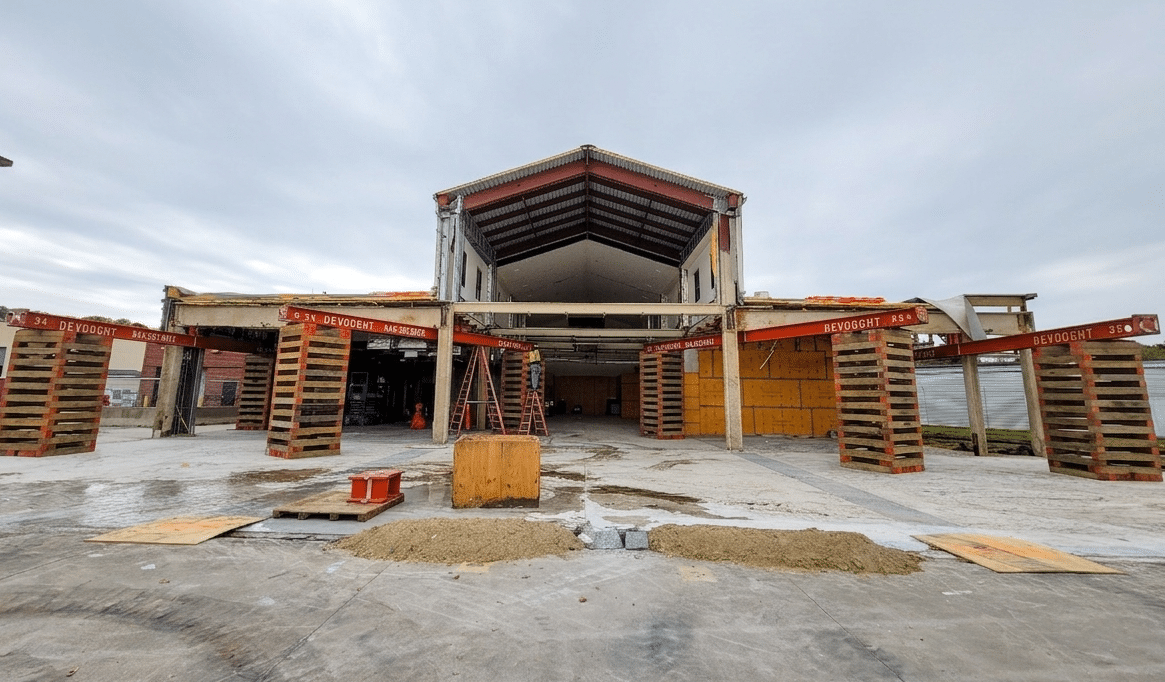
Most underpinning contractors never raise this scenario because piers are the only product they sell. We install helical pile underpinning, and we also do something most of them cannot: we lift entire structures off failed foundations so a new one can be built underneath. Our house lifting crews carry 2.5 million pounds of steel beams and sixty thousand cribbing blocks for exactly this work. That range lets us recommend the repair your house needs instead of the one we happen to offer.
“We’ve lifted homes off foundations that were eighty years old and falling apart from the inside. The house itself was perfectly sound. Lifting it and building a new foundation gave those homeowners a structure that will last another eighty years.” – David DeVooght
The dividing line is simple. If the foundation material is sound and the soil failed, underpin it. If the foundation material itself has failed, or the home needs to come up anyway to meet flood elevation requirements, lifting and replacing is usually the better long-term spend. Whichever path applies, you deserve proof that the work performed as promised.
How Do You Know the Underpinning Actually Worked?
This is the question almost no one teaches homeowners to ask. With mass concrete, you are trusting that the excavated pits reached good soil. With push piers, you are trusting the installer’s reading of hydraulic pressure. Helical piles are different: installation torque correlates directly with load capacity, so every pile produces a measurable record proving it reached soil that carries the design load.
On our installations, crews document torque, depth, and configuration for every pile, and that log goes to the engineer of record and the inspector. As a CHANCE and CANTSINK certified installer, we are required to produce it. For you, that paperwork means the repair is not a promise. It is a verified number attached to your property file, which also matters the day you sell, because a documented, engineered repair reassures buyers in a way a paid invoice never will. Homeowners weighing this option can start with our overview of helical piles for homeowners.
Ask any underpinning bidder two questions: how will you verify each pier reached capacity, and will I receive that documentation? The answers tell you more about the contractor than any review page.
Talk to a Team That Can Fix the Foundation or Replace It
The DeVooght team has spent more than fifty-five years lifting, stabilizing, and rebuilding the ground under homes across New Jersey, the Carolinas, and Wisconsin. Because we handle both helical pile underpinning and full lift-and-replace foundation projects, our recommendation starts with your soil and your structure, not with the one product we need to sell. If you are seeing settlement and want a straight answer about foundation repair or underpinning, call us at 844-203-9912 or reach out through our contact page.