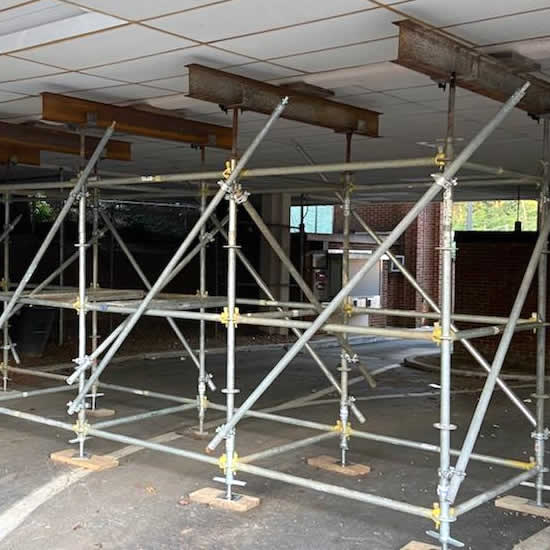
A house fire does not stop doing damage when the flames go out. The heat weakens framing members, warps steel connections, and degrades concrete. The water used to fight the fire saturates walls, ceilings, and foundations, adding weight to components that are already compromised. Without immediate stabilization, a fire-damaged building can continue to shift, sag, or collapse in the hours and days that follow. Emergency structural shoring is the temporary support system that holds a fire-damaged structure in place long enough for professionals to assess the damage, determine whether the building can be saved, and plan the permanent repair.
Key Takeaways
- Fire affects wood, steel, and concrete in different ways, and each material requires a different assessment approach before shoring is placed.
- Water from firefighting efforts compounds the structural damage by adding weight, accelerating rot, and promoting concrete spalling.
- A structural engineer’s assessment must happen before shoring begins to identify which elements are still carrying load and which have failed.
- Emergency shoring is always temporary. The permanent solution may involve foundation repair, house lifting, structural relocation, or in some cases, full rebuilding on a new foundation.
- Working with a team that can move directly from stabilization to permanent structural work reduces costs, timelines, and the risk of handoff errors between contractors.
Why Does Fire Damage Require a Different Shoring Approach Than Storm Damage?
Storm and flood damage typically compromises a building from the outside in. Wind removes roof sections, water undermines foundations, and debris impacts walls. Fire works from the inside out. It consumes structural members, reduces their load-carrying capacity, and leaves behind components that may look partially intact but have lost the strength to support what sits above them. A charred 2×10 floor joist, for example, may still be in place and appear to be doing its job, but the fire may have reduced its effective cross-section by 30% or more. That joist is now carrying the same load with significantly less material.
This is what makes post-fire shoring more complex than post-storm shoring. With storm damage, you can often see where the failure occurred and shore up around it. With fire damage, the failure may be hidden inside walls, above ceilings, or within connections that are covered by soot and debris. A shore placed against a wall that appears solid but has lost its bearing capacity can create a false sense of security, or worse, concentrate the load on a point that cannot support it.
“After a fire, the structure you’re looking at is not the structure that was built. The materials have changed. Wood has lost cross-section. Steel may have warped or become brittle from rapid cooling. Concrete may have spalled to the point where rebar is exposed. You have to assess what you actually have before you decide how to support it.” – Jason DeVooght
How Does Fire Affect Different Structural Materials?
The type of construction your building uses determines how fire changes its structural behavior and what kind of shoring response is appropriate. Each material fails differently under heat, and those differences shape the assessment and stabilization plan.
How common building materials respond to fire exposure:
- Wood framing: Fire chars wood from the outside in, creating a layer of charcoal that actually insulates the interior. The structural capacity of a wood member after fire depends on how much uncharred cross-section remains. Wood burns at roughly 0.5 inches per minute of exposure, so the depth of char directly correlates to how much strength is left. Joints and connections are the biggest concern because steel fasteners, nails, and plates conduct heat into the interior of the wood, causing hidden charring that is not visible from the surface.
- Steel framing and connections: Steel begins losing strength at around 300°C (570°F) and loses roughly 40% of its yield strength by 550°C. If steel was heated and then rapidly cooled by fire suppression water, a brittle phase called martensite can form, making the steel prone to sudden fracture rather than gradual bending. Visible signs include warping, buckling, discoloration, and loss of protective coatings. If the steel shows no deformation, it likely did not reach temperatures high enough to permanently alter its properties.
- Concrete foundations and walls: Concrete does not burn, but extreme heat causes it to lose compressive strength and can trigger explosive spalling, where chunks of the surface break away under internal steam pressure. This spalling can expose rebar to heat, which weakens the reinforcement. A sounding hammer test (sharp ring = sound concrete, dull thud = damaged) is one of the first field checks an engineer will perform.
Understanding these material-specific responses is what separates an informed shoring plan from a guess. The shoring system needs to account for what each remaining element can and cannot support.
What Should Happen Before Any Shoring Is Placed?
The urge to stabilize a fire-damaged building immediately is understandable, but placing shores without an assessment can cause more harm. A qualified structural engineer should inspect the building and identify which elements are still carrying load, which have partially failed, and which have failed entirely. This inspection follows a systematic approach.
Critical steps in a post-fire structural assessment:
- Exterior survey first: Check for leaning walls, sagging rooflines, displaced foundation sections, and any visible cracks or separation at corners. Do not enter the building until the exterior indicates it is stable enough for limited access.
- Char depth and material testing: For wood structures, measure the depth of charring on exposed framing. For concrete, perform sounding hammer tests and visual inspections for spalling and color change (pink or red discoloration indicates temperatures above 300°C). For steel, look for warping, buckling, or discoloration.
- Water damage assessment: Fire suppression adds thousands of gallons of water to a building. That water saturates framing, adds dead load to floors and ceilings, and can undermine soil bearing capacity beneath foundations. The combined effect of fire weakening and water loading is often more dangerous than either condition alone.
- Hazardous materials check: Older homes may contain asbestos in insulation, flooring, or siding, and lead paint on walls and trim. Fire can release and redistribute these materials. Any shoring plan must account for safe access protocols.
“We’ve worked on older homes where the fire itself did less damage than the water that came after it. Thousands of gallons soaking into plaster, lathe, and old-growth framing adds tremendous weight to a structure that is already weakened. That water loading is the thing most people overlook, and it is often the reason a building fails days after the fire is out.” – The team at DeVooght
When Can a Fire-Damaged Building Be Saved Through Lifting or Foundation Work?
Not every fire-damaged building needs to be demolished. If the primary structural frame is still intact and the foundation has not been critically compromised, the building may be a candidate for house lifting, foundation replacement, or both. This is particularly true for historic structures, where demolition means losing irreplaceable architectural character.
The decision comes down to whether the remaining structural capacity can support the building through a lift and onto a new foundation. If the framing retains sufficient cross-section after charring and damaged members can be sistered or replaced before lifting, the structure can often be stabilized, raised, and set on a new foundation built to current codes. Helical pile systems are especially useful in these situations because they can be installed quickly, bear load immediately, and do not require the curing time that poured concrete demands.
“Demolition is the easy answer, but it is not always the right one. We’ve stabilized and lifted buildings that other contractors wrote off. When the bones of a structure are still sound, and the owner has a reason to save it, our job is to figure out how to get it done safely. That starts with an honest assessment and a shoring plan that accounts for every compromised element.” – David DeVooght
Working with a single team that handles stabilization, structural assessment, and permanent lifting or foundation work removes the coordination gaps that slow recovery and increase cost. When the shoring and lifting crews are the same people, the temporary support system can be designed from the start to work with the hydraulic jacking equipment and lifting methods that will follow.
How the DeVooght Team Can Help After a Fire
DeVooght House Lifters brings more than 55 years of structural stabilization and lifting experience to fire-damaged properties, with a fleet of 11 Unified Hydraulic Lifting Machines and over 2.5 million pounds of steel beams staged across five equipment locations. Our team has earned 35+ international and regional awards from the International Association of Structural Movers, and our CHANCE Certified helical pile installation capability means we can move from emergency stabilization to permanent foundation work without handing the project off to another contractor.
If your home or building has been damaged by fire and you need to understand your stabilization and recovery options, contact the DeVooght team at 844-203-9912 or through our website.