Historic homes carry more than architectural beauty. They hold stories, craftsmanship, and cultural significance that modern construction rarely replicates. When those foundations begin to fail, though, property owners face a difficult question: how do you stabilize a 100-year-old structure without tearing apart the very features that make it worth saving? Helical pile foundation installation has answered that question for thousands of preservation projects across the country. These steel-shaft deep foundation systems screw into load-bearing soil with minimal noise, zero excavation waste, and virtually no vibration, making them uniquely suited to fragile historic buildings that cannot tolerate the disruption of traditional foundation methods.
What Are Helical Piles and How Do They Work in Older Buildings?
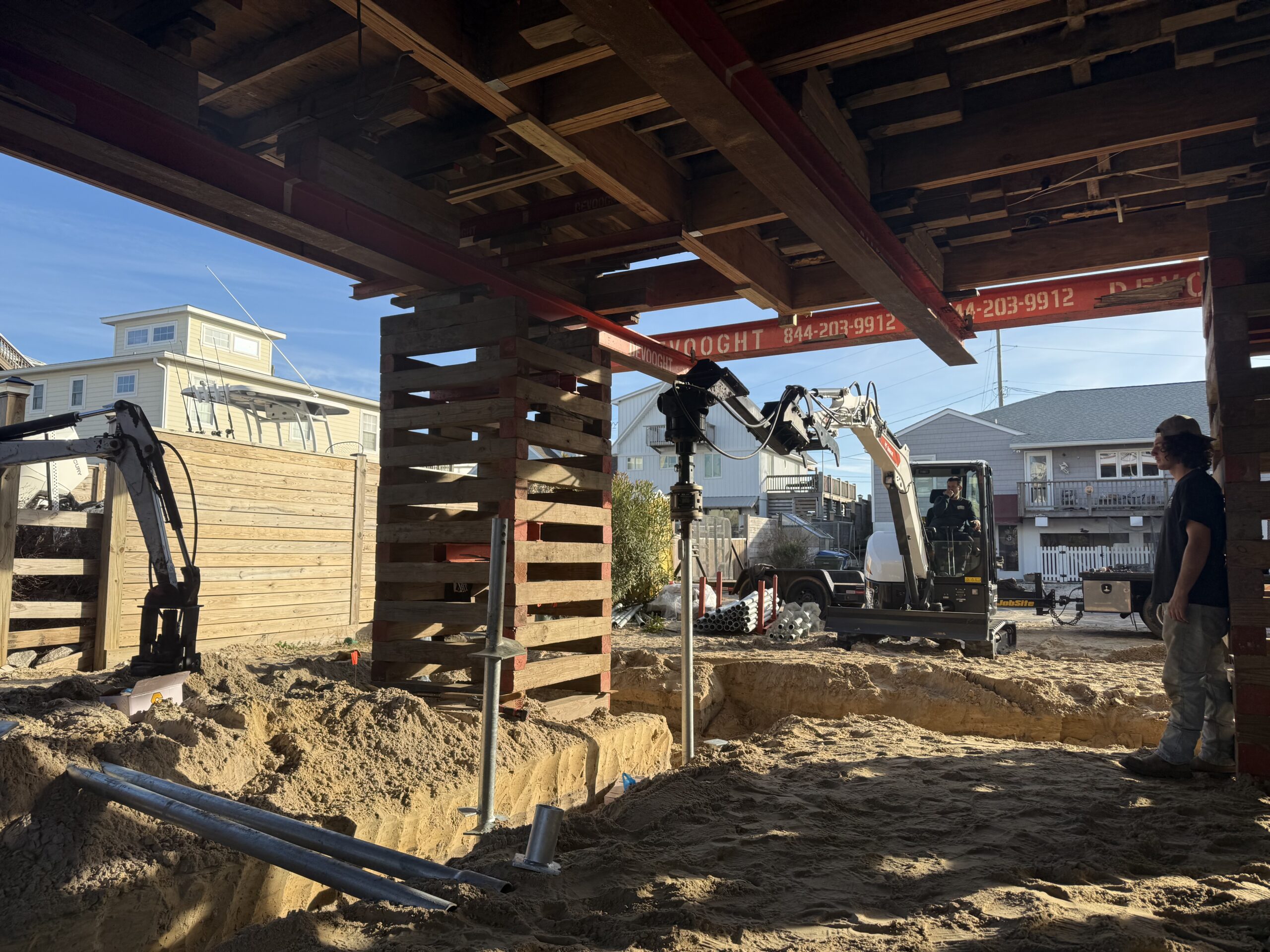
Helical piles (also called screw piles or helical piers) are steel shafts fitted with one or more spiral-shaped plates near the tip. During installation, a hydraulic torque motor rotates the shaft into the ground, much like turning a large screw into wood. As the pile advances through weak surface soils, the helical plates anchor into deeper, more competent strata capable of supporting the structural load above.
What makes this technology so well suited to older buildings is its installation method. Traditional driven piles rely on high-impact hammering that sends shockwaves through the surrounding soil and structure. For a building with original plaster walls, hand-laid brick, or ornamental masonry, those vibrations can cause cracking, spalling, and irreversible damage. Helical piles, by contrast, are installed through slow, steady rotation using a hydraulic torque head. The process creates no soil cuttings to dispose of, requires no open excavation pits, and generates virtually no construction vibration.
The portable equipment used for installation can also be managed by a single operator and maneuvered into tight spaces, basements, and crawl spaces, areas common in older structures where access is restricted. Short extension sections allow the piles to be installed from inside a building, with the power unit placed outside and hydraulic hoses routed through a window or small opening.
Key technical characteristics of helical piles for historic applications:
- Torque-monitored installation: Real-time torque readings during installation verify soil conditions and confirm that each pile meets the required load capacity before the crew moves on. This is particularly valuable under historic structures where soil conditions may be unknown or undocumented.
- Configurable geometry: Helix diameter, number of helices, shaft size, and installation length can all be adjusted to match the specific load requirements of the building. This flexibility allows engineers to design a foundation system tailored to each project.
- Immediate load transfer: Unlike poured concrete foundations that require curing time, helical piles can bear weight immediately after installation, reducing the overall project timeline and the period of structural vulnerability.
- Reversible installation: If a pile needs to be removed or repositioned, it can be unscrewed from the ground, which is a meaningful consideration for properties subject to preservation oversight.
“We have seen helical piles save structures that property owners had nearly given up on. The ability to stabilize a foundation from the inside out, with almost no visible disruption to the building’s exterior, is what makes this technology a preservation tool rather than just a construction method.” – The Team at DeVooght
Why Do Historic Foundations Fail, and What Makes Repair So Challenging?
Understanding why older foundations deteriorate helps explain why helical piles have become the preferred repair solution in preservation contexts. Most historic homes in the eastern United States were built on shallow stone, brick, or unreinforced concrete footings. These materials were adequate for the soil conditions and structural loads of their era, but time, moisture, and shifting ground have taken a toll.
Common causes of foundation failure in historic buildings:
- Soil settlement and consolidation: Over decades, the soil beneath a shallow footing compresses unevenly, causing the structure above to crack, lean, or sink. Clay-heavy soils are especially prone to this, swelling when wet and shrinking when dry.
- Water infiltration: Older drainage systems (or the complete absence of them) allow water to erode and weaken the soil around footings. In coastal and flood-prone areas, repeated saturation accelerates this process.
- Material degradation: Lime mortar, fieldstone, and early concrete mixes break down over time, especially when exposed to freeze-thaw cycles or acidic groundwater.
- Undocumented fill: Many historic properties sit on soil that was backfilled with rubble, organic material, or other unstable fill, material that was never engineered to support a permanent structure.
The challenge with repairing these foundations is that the repair process itself can cause more harm than the original problem. Conventional underpinning methods typically require extensive excavation around and beneath the existing footings. For a historic building, that digging can undermine adjacent walls, disturb archaeological resources, or damage original landscaping and site features. Driven pile systems produce impact vibrations that threaten delicate interior finishes like horsehair plaster, decorative moldings, and stained glass. Even the heavy equipment needed for traditional deep foundation work can compact surrounding soils or damage historic pavement and walkways.
Helical piles sidestep these problems. Because they are screwed, not hammered, into the ground, the installation process is gentler on both the structure and the surrounding site. The compact equipment fits through existing openings, and the absence of soil spoils means no truckloads of excavated earth leaving the property.
Comparison of foundation repair methods for historic structures
| Factor | Helical Piles | Driven Piles | Traditional Underpinning |
|---|---|---|---|
| Vibration Level | Virtually none | High impact | Moderate (from excavation) |
| Excavation Required | Minimal to none | Moderate | Extensive |
| Confined Space Access | Excellent (portable equipment) | Poor | Limited |
| Soil Spoils Generated | None | Minimal | Significant |
| Load Capacity Verification | Real-time torque monitoring | Post-installation testing | Post-installation testing |
| Time to Load Bearing | Immediate | Immediate | Days to weeks (concrete curing) |
| Reversibility | Can be unscrewed | Permanent | Permanent |
| Risk to Historic Fabric | Low | High | Moderate to High |
How Do Helical Piles Comply With the Secretary of the Interior’s Standards for Rehabilitation?
Any work on a building listed in or eligible for the National Register of Historic Places must follow the Secretary of the Interior’s Standards for Rehabilitation if the owner intends to qualify for the Federal Historic Preservation Tax Credit. These ten standards, codified in 36 CFR Part 68, are the regulatory criteria the National Park Service uses to determine whether a rehabilitation project is “certified” and eligible for the 20% federal tax credit on qualified rehabilitation expenditures.
Helical piles align naturally with several of these standards. Standard 2 requires that the historic character of a property be retained and preserved, and that removal of distinctive materials or alteration of character-defining features be avoided. Because helical pile installation produces no vibration damage to original plaster, masonry, or woodwork, and requires no removal of historic building fabric, it satisfies this requirement in a way that hammer-driven piles or open-pit excavation simply cannot.
Standard 9 states that new additions, exterior alterations, or related new construction should not destroy historic materials, features, or spatial relationships. It also requires that new work be differentiated from old and be compatible with the property in materials, features, size, and scale. Helical piles installed below grade are invisible once the project is complete, leaving the building’s exterior appearance unaltered. And Standard 10 mandates that new additions and construction be undertaken so that, if removed in the future, the property’s form and integrity would remain unimpaired. The reversibility of helical pile systems, where piles can be unscrewed if needed, directly supports this principle.
“Meeting the Secretary of the Interior’s Standards is not just about checking a box for tax credit eligibility. It is about respecting the building’s identity. Helical piles let us do necessary structural work without compromising the qualities that earned the building its historic designation in the first place.” – The Team at DeVooght
For property owners pursuing the Historic Tax Credit, this matters financially. The NPS reported that in fiscal year 2024, 853 properties received Part 3 certifications of completed work, and the program has attracted more than $127 billion in private investment since 1976. Choosing a foundation method that jeopardizes certification could cost an owner 20% of their qualified rehabilitation expenditures in lost credits.
What Types of Historic Structures Benefit Most From Helical Pile Foundations?
Helical piles are not limited to one architectural style or building type. Their adaptability makes them practical for a wide range of historic structures, from small residential properties to large commercial buildings being adapted for new uses.
Building types where helical piles are commonly used in preservation work:
- Residential historic homes: Queen Anne Victorians, Colonial-era farmhouses, antebellum estates, Craftsman bungalows, and other period residences with failing stone or brick foundations. The residential segment of the foundation repair market is growing at roughly 6.8% annually through 2035, with aging housing stock as a primary driver.
- Downtown commercial buildings: Former banks, department stores, and office buildings listed in National Register historic districts. These structures often sit on aging shallow foundations and face increased loading demands during adaptive reuse conversions into apartments, hotels, or mixed-use spaces.
- Religious and institutional buildings: Churches, courthouses, and school buildings with heavy masonry construction and limited access to foundation areas. The portable equipment and confined-space capability of helical pile systems make interior installation possible even in tight basements.
- Coastal and flood-zone historic properties: Historic structures in areas subject to flooding, storm surge, or shoreline erosion often need both structural stabilization and elevation. Helical piles can serve as the new deep foundation system after a home is lifted above the base flood level.
- Industrial heritage buildings: Former mills, warehouses, and factories being converted to new uses. These large-footprint buildings frequently sit on questionable fill soils and need deep foundation support that traditional methods cannot provide without disrupting the historic shell.
The global screw piles market, valued at approximately $1.8 billion in 2023, is projected to reach $3.4 billion by 2032, growing at a compound annual rate of 7.5%. Much of that growth is driven by residential and commercial applications where minimal site disruption is a priority, a description that fits historic preservation work exactly.
What Does the Helical Pile Installation Process Look Like on a Historic Property?
A helical pile project on a historic building follows a more deliberate sequence than a standard foundation repair job. Preservation projects require coordination between structural engineers, geotechnical consultants, experienced house lifting professionals, and often the State Historic Preservation Office (SHPO) or local historic commission.
Typical project phases for helical pile installation on a historic building:
- Geotechnical investigation: Soil borings and analysis determine the depth to competent load-bearing soil, identify obstructions, and characterize the subsurface conditions. For historic properties, this investigation must also account for potential archaeological resources beneath the structure.
- Engineering design: A licensed professional engineer designs the pile layout, specifying shaft diameter, helix configuration, installation depth, and spacing based on the building’s loads and the geotechnical data. For projects involving the Historic Tax Credit, the design must also demonstrate compatibility with the Secretary of the Interior’s Standards.
- Pre-construction documentation: Before any work begins, the existing condition of the building’s historic features is photographed and documented. This record protects the owner and provides evidence for SHPO review and tax credit applications.
- Installation: Hydraulic equipment rotates each pile into the ground to the specified depth while the operator monitors torque readings in real time. On most residential projects, installation of each pile takes approximately 15 to 30 minutes. A typical home may need anywhere from 5 to 15 or more piles depending on the structure’s size and the severity of the foundation problem.
- Load transfer: Once installed, brackets connect the piles to the existing foundation, transferring the building’s weight from the failing shallow footing to the deep, stable soil. In some cases, hydraulic jacks are used to carefully lift the structure back toward its original level before the brackets are locked off.
- Post-installation verification: Load testing confirms that each pile meets design specifications. Documentation of torque values, pile depths, and load test results becomes part of the project record.
A residential helical pile installation commonly costs between $1,500 and $4,000 per pier, with most homes requiring five to ten piers. The total project cost for a typical two-story historic home with moderate foundation settlement usually falls in the $15,000 to $30,000 range, though larger or more complex projects can exceed that figure.
Typical helical pile cost factors for historic properties
| Cost Factor | Impact on Price | Notes |
|---|---|---|
| Number of piles required | Primary cost driver | Each additional pile adds ~$1,500-$4,000 |
| Depth to load-bearing soil | High | Deeper installations require more shaft extensions |
| Access constraints | Moderate to High | Interior installation or tight lots increase labor time |
| Soil obstructions | Moderate | Rock, rubble, or debris may require pre-drilling |
| Preservation documentation | Moderate | Photo documentation, SHPO coordination, tax credit paperwork |
| Structural lifting | Moderate to High | Releveling a settled structure adds engineering and labor cost |
| Local permitting | Low to Moderate | Historic districts may require additional review and fees |
“One of the biggest advantages of helical piles on a preservation project is the speed. We can often stabilize a failing historic foundation in a matter of days rather than weeks, which means less time the building is vulnerable and less disruption to the surrounding neighborhood.” – The Team at DeVooght
Can Helical Piles Help Qualify a Project for the Federal Historic Tax Credit?
The Federal Historic Preservation Tax Incentives Program offers a 20% federal income tax credit on qualified rehabilitation expenditures for income-producing historic buildings. Since 1976, the program has certified more than 50,000 projects nationwide, producing over 3.3 million jobs and generating more than $52.9 billion in federal tax revenue, actually exceeding the $47 billion cost of the program itself.
To qualify, a rehabilitation must be “certified” by the National Park Service as consistent with the historic character of the building. This is where the choice of foundation method matters. A repair technique that damages original materials, alters character-defining features, or introduces irreversible changes to the structure can result in project denial, disqualifying the entire rehabilitation from the tax credit.
Helical piles support tax credit eligibility in several practical ways. They produce no damage to historic materials during installation. They remain below grade, preserving the building’s visual and spatial character. They are reversible, meeting the Standard 10 requirement that new work be removable without impairing the property. And the detailed torque and load documentation generated during installation provides the kind of engineering records that NPS reviewers expect to see in a well-documented rehabilitation project.
According to the NPS, 78% of all certified rehabilitation projects in fiscal year 2022 were in economically distressed areas, and 29% were in communities with fewer than 50,000 people. These are often the communities where historic homes are most at risk of demolition due to deferred maintenance and failing foundations. Helical piles give property owners a path to structural stability that keeps the building eligible for the financial incentives designed to encourage preservation.
Federal Historic Tax Credit program at a glance
| Program Detail | Data |
|---|---|
| Tax credit rate | 20% of qualified rehabilitation expenditures |
| Total projects certified (through 2024) | Over 50,000 |
| Private investment attracted (since 1976) | $127+ billion |
| Jobs created (since 1976) | 3.3+ million |
| Housing units rehabilitated or created | 650,000+ |
| FY 2024 investment in certified projects | $6.15 billion |
| Projects in economically distressed areas (FY 2022) | 78% |
What Should Property Owners Consider Before Choosing Helical Piles for a Historic Home?
While helical piles are the right solution for many historic preservation projects, every building presents unique conditions. Here are the factors that matter most when evaluating whether helical piles are appropriate for your property.
Evaluation criteria for helical pile suitability on historic buildings:
- Soil composition: Helical piles perform well in most soil types, including clay, silt, sand, and mixed fills. Extremely rocky ground or soil with large buried debris can present challenges, sometimes requiring pre-drilling or alternative helix configurations. A geotechnical investigation is always the first step.
- Building construction type: Helical piles have been successfully used on wood frame, brick masonry, stone, concrete block, and timber frame structures. The pile design and bracket configuration are adjusted to match the building’s construction and load distribution.
- Preservation oversight requirements: If the property is listed on or eligible for the National Register, any foundation work will likely require review by the SHPO or a local historic commission. Working with a contractor experienced in preservation projects, one who understands the documentation and review process, is important.
- Flood zone considerations: For historic homes in flood-prone areas, helical piles can serve a dual purpose: stabilizing the existing foundation and providing the deep foundation system needed if the home needs to be lifted above the base flood elevation. This combination of flood mitigation and preservation is especially relevant along the Atlantic coast and in river communities.
- Budget and timeline: Helical pile installation is typically faster and produces fewer secondary costs (site restoration, debris hauling, temporary shoring) than traditional methods. That said, projects involving the Historic Tax Credit carry additional administrative costs for documentation and NPS review. Factor these into the overall budget.
- Contractor qualifications: Not every foundation repair company has experience with historic structures. Look for a contractor who is a certified installer (such as a CHANCE certified installer), carries proper licensing and insurance, and can provide references from completed preservation projects.
“We always tell property owners that the foundation decision you make today will define the building’s next 50 to 100 years. With a historic home, that decision carries even more weight because you are also deciding whether the building’s story continues or ends.” – The Team at DeVooght
How Are Coastal Historic Homes Using Helical Piles for Both Preservation and Flood Protection?
Along the Atlantic seaboard and Gulf Coast, thousands of historic homes sit in FEMA-designated flood zones. These properties face a double threat: their original shallow foundations are deteriorating, and rising flood insurance costs and updated flood plain regulations are pressuring owners to either raise the building above the base flood elevation or face increasingly expensive insurance premiums.
Helical piles offer a solution to both problems simultaneously. When a historic coastal home needs to be lifted, helical piles can be installed as the new deep foundation system that supports the raised structure. This approach replaces aging, shallow footings with a modern foundation anchored in stable soil well below the surface, while the house lifting process positions the building above flood level.
For communities like Beaufort, South Carolina’s Historic Point District, where antebellum homes face growing flood risk, or the Outer Banks of North Carolina, where shoreline erosion threatens historic beach communities, this combination of structural lifting and foundation stabilization is becoming a standard preservation strategy.
Helical piles also offer environmental advantages in sensitive coastal settings. Traditional pile-driving generates noise that can disturb wildlife in adjacent marshes and waterways. Open excavation near tidal creeks or wetlands risks sediment runoff and habitat disruption. Helical piles, installed with low noise and no soil displacement, are a better fit for projects in environmentally sensitive coastal areas where both preservation regulations and environmental protections apply.
The National Park Service has published specific Guidelines on Flood Adaptation for Rehabilitating Historic Buildings, recognizing that making historic structures more flood-resistant is a growing priority. These guidelines emphasize that flood adaptation measures should preserve the building’s historic character, exactly the outcome that helical piles are designed to deliver.
Conclusion
Preserving a historic home means protecting more than its appearance. It means safeguarding the structural foundation that holds everything together, without compromising the original materials, craftsmanship, and character that earned the building its place in history. Helical piles give property owners, engineers, and preservation professionals a foundation repair method that works with the building rather than against it: quiet installation, zero excavation waste, real-time load verification, and full compliance with the standards that govern historic rehabilitation work.
At DeVooght, our team of structural lifting and foundation specialists has spent years working on historic properties where getting the foundation right is not optional. We understand the coordination required with State Historic Preservation Offices, the documentation standards for tax credit eligibility, and the engineering precision that fragile older buildings demand. If you are facing foundation problems on a historic property, or if you need to combine foundation stabilization with house lifting for flood protection, contact the DeVooght team to discuss how we can help with your historic home preservation and structural lifting needs.