North Carolina’s Coastal Plain covers roughly 45% of the state, stretching from the Outer Banks to the Sandhills. Beneath the surface, the soil here is predominantly sandy, loose, and often saturated by a high water table. For homeowners building, repairing, or elevating a coastal property, that soil profile creates a real challenge: how do you anchor a foundation into ground that shifts, drains fast, and sits just feet above sea level? Helical piles are answering that question for a growing number of NC coastal property owners, and the performance data backs them up.
What Makes North Carolina’s Coastal Soil So Challenging for Foundations?
The helical piles foundation conversation always starts with the soil. North Carolina’s Coastal Plain is made up of unconsolidated marine and fluvial deposits, which is a technical way of saying the ground is composed of sand, silt, and sediment left behind by ancient oceans and rivers. According to the NC Department of Agriculture and Consumer Services Agronomic Division, Coastal Plain soils are predominantly sandy, with some areas featuring organic-rich histosols in the tidewater regions. The USDA classifies much of the sandhill soil in this region as loose, gray, and ranging from 10 to 50 feet in depth.
That sandy composition affects foundations in several ways. Sand does not absorb water the way clay does, so it avoids the shrink-swell cycles that plague Piedmont foundations. But sand also lacks cohesion. Without the binding strength of clay particles, sandy soil can shift under load, erode during storm surges, and allow structures to settle unevenly over time. Pair that with a water table that often sits just a few feet below the surface in areas like the Outer Banks, Wilmington, and Beaufort, and you get a soil profile that demands a foundation system reaching down to competent, stable strata far below the surface.
Key Soil Challenges for NC Coastal Foundations
| Soil Characteristic | Impact on Foundations | How Helical Piles Address It |
|---|---|---|
| Low cohesion (loose sand) | Settlement and shifting under load | Helix plates bear on dense soil layers below unstable surface sand |
| High water table | Saturated ground reduces bearing strength | Steel shaft bypasses saturated zones to reach firm strata |
| Erosion and scour potential | Storm surges remove soil from around footings | Deep embedment resists undermining from erosion |
| Low SPT blow counts near surface | Top soil layers cannot support structural loads | Piles extend to depths where blow counts exceed 20 |
| Salt content in groundwater | Accelerated corrosion of buried metal | Hot-dip galvanization and sacrificial steel thickness protect against salt exposure |
“Sandy coastal soil doesn’t forgive shortcuts. We see foundation failures on the NC coast almost always trace back to one issue: the original system didn’t reach deep enough into competent ground. Helical piles solve that by screwing past the problem and locking into stable bearing layers.” – The Team at DeVooght
How Do Helical Piles Actually Work in Sand?
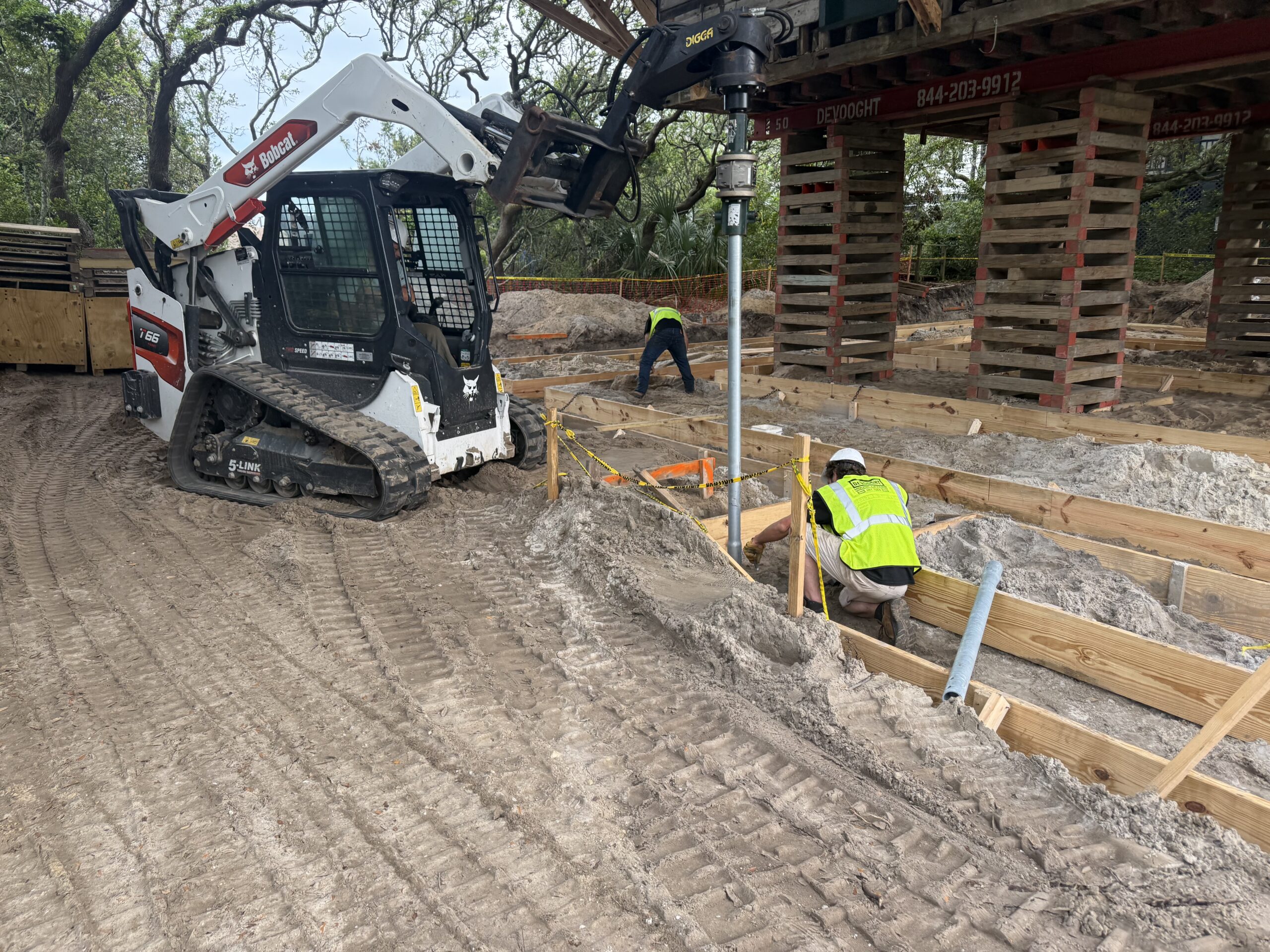
A helical pile is a steel shaft fitted with one or more spiral-shaped bearing plates (called helices) welded along its length. Installation crews use hydraulic equipment to rotate the pile into the ground, much like driving a large screw into wood. As each helix plate advances through the soil, it bears against the surrounding material and generates measurable resistance. That resistance, recorded as installation torque, directly correlates with the pile’s load-bearing capacity.
In sandy soil, the bearing plates carry the majority of the axial load. Research published in Acta Geotechnica confirms that in sand, more of the load transfers through the helix plates than the shaft itself, with the plates’ contribution increasing as the pile approaches its maximum capacity. The capacity-to-torque ratio (Kt) tends to be higher in sands than in clays, meaning installers can verify performance with greater confidence during the installation process itself.
The standard practice uses Terzaghi’s bearing capacity equation to calculate the load each helix plate can support at its installed depth. For NC coastal projects, engineers will typically review Standard Penetration Test (SPT) blow count data from geotechnical borings to map the soil profile and identify where dense sand or firm bearing layers begin. In many coastal NC sites, surface blow counts may fall below 10, but competent layers with blow counts above 20 often appear at depths of 15 to 30 feet, precisely the range where helical piles are designed to anchor.
Helical pile components that influence sandy soil performance:
- Helix plate diameter: Larger plates (10 to 14 inches) distribute load across a wider area of sand, which matters in loose conditions where smaller plates might punch through without adequate resistance.
- Helix spacing: Plates are typically spaced three diameters apart along the shaft. This prevents stress overlap between adjacent plates, so each one bears independently against undisturbed soil.
- Shaft diameter and type: Round shafts (2-7/8 inch to 4-1/2 inch) are common in NC coastal applications. Round shafts perform better than square shafts under lateral loads from wind and storm surge, a real concern on the coast.
- Installation depth: Deeper installations produce higher capacities in the same soil. Engineers calculate the target depth using soil boring data and torque requirements to confirm the pile has reached stable ground.
How Do Helical Piles Compare to Traditional Pilings in Coastal NC?
North Carolina’s Residential Code, Chapter 46, has historically required that homes in coastal high-hazard areas and ocean hazard areas use pile foundations of wood or concrete. Timber pilings and concrete pilings have been the standard for decades. But helical piles are gaining traction as a CHANCE-certified foundation option that addresses several shortcomings of traditional methods in sandy environments.
Timber pilings are susceptible to rot, marine borers, and splitting over time. In the salt-laden soils and brackish groundwater common along the NC coast, wood decay accelerates. Concrete piles avoid the biological degradation issue, but they require curing time, excavation, and heavy equipment for driving. If a concrete pile is poured on-site and soil conditions cause poor curing, the finished product may crack or settle. Both traditional methods also create significant noise and vibration during installation, an issue in established neighborhoods and environmentally sensitive coastal areas.
Foundation Method Comparison for NC Coastal Sandy Soil
| Factor | Helical Piles | Timber Pilings | Concrete Pilings |
|---|---|---|---|
| Installation time | Hours (per pile) | Hours to days | Days to weeks (with curing) |
| Immediate load capacity | Yes, upon reaching target torque | Yes, after driving | No, requires curing time |
| Noise and vibration | Minimal | High (pile driving) | Moderate to high |
| Corrosion/decay risk | Low with galvanization | High (rot, marine borers) | Moderate (cracking, spalling) |
| Capacity verification during install | Yes (torque monitoring) | Limited | Post-cure testing only |
| Environmental disruption | Minimal (no excavation, no spoils) | Moderate | High (excavation, waste) |
| Estimated service life | 75-150+ years (galvanized) | 20-40 years (treated) | 50-75 years |
One of the most significant advantages in sandy coastal conditions is real-time capacity verification. As a helical pile is screwed into the ground, the installing crew monitors torque continuously. When the measured torque reaches the target value calculated by the engineer, the crew knows the pile has seated into a bearing layer capable of supporting the design load. With traditional driven piles, capacity is estimated from driving resistance, but that metric is less precise in loose sands where refusal may not occur at the ideal depth.
“We work with homeowners across the NC coast who are surprised to learn they have more foundation options than timber or concrete. Helical piles let us verify capacity in real time during installation, which takes a lot of guesswork out of building on sandy ground.” – The Team at DeVooght
What Happens to Steel Helical Piles in Salty, Wet Coastal Soil?
Corrosion is the first concern most homeowners raise about steel foundations in a saltwater environment, and it’s a fair question. The sandy coastal soils of NC often contain dissolved salts from ocean spray, tidal influence, and brackish groundwater. These salts increase the electrical conductivity of the soil, which in turn raises the potential for electrochemical corrosion of buried steel.
The industry has addressed this concern through several well-tested strategies. Hot-dip galvanization, applied per ASTM A123/A153 standards, coats the steel shaft and helix plates with a zinc layer that acts as a sacrificial barrier. According to CHANCE (a Hubbell brand and one of the leading helical pile manufacturers in the U.S.), their products carry an average coating thickness of 4 mils, which translates to an average service life exceeding 50 years under typical conditions. For reference, the ICC-ES AC358 acceptance criteria for helical foundation systems set a baseline design lifespan of 75 years for bare steel in moderate soil conditions. Hot-dip galvanization can more than double that figure.
Beyond galvanization, engineers account for corrosion through sacrificial steel thickness. The steel required to develop installation torque far exceeds the steel needed to resist the actual design load. Supportworks, a national helical pile engineering firm, published data showing that a pile designed for 35 kips of allowable capacity would not fall below that capacity until the sacrificial thickness loss reached between 0.135 and 0.140 inches. That figure is nearly four times the predicted 50-year corrosion loss for bare steel and more than ten times the loss rate for galvanized steel.
For NC coastal properties in the most aggressive soil environments (soil resistivity below 1,000 ohm-cm or pH below 5.5), additional protection such as epoxy powder coating or coal tar epoxy can extend service life another 16 or more years. Geotechnical investigations at the project site should include soil pH and resistivity testing to determine which level of corrosion protection is appropriate.
Factors that influence corrosion risk for helical piles in NC coastal soil:
- Soil resistivity: Lower resistivity means higher corrosion potential. Sandy soils with salt infiltration can fall below the 1,000 ohm-cm threshold that marks severe conditions.
- Soil pH: Most NC coastal soils are mildly acidic to neutral. Soils below pH 5.5 are considered aggressive for buried steel.
- Oxygen availability: Oxygen decreases rapidly below the first few feet of soil, and below the water table. Less oxygen means slower rusting, though other forms of galvanic corrosion can still occur.
- Galvanization thickness: A 4-mil zinc coating provides decades of protection, and thicker coatings proportionally extend that timeline.
Why Are Helical Piles a Strong Fit for House Lifting and Flood Zone Projects?
Much of North Carolina’s coast falls within FEMA-designated Special Flood Hazard Areas (SFHAs), and the National Flood Insurance Program requires that new construction and substantially improved structures in V-zones (coastal high-hazard areas) be elevated on open foundations like piles or columns. The 2024 NC Residential Code, Chapter 46, reinforces this by mandating pile foundations for one- and two-family dwellings in coastal high-hazard and ocean hazard areas.
For homeowners working with a house raising company to lift an existing home above the base flood elevation, helical piles offer several practical benefits. Traditional house lifting services for flood prevention often involve temporarily supporting the structure on cribbing, then installing new foundation piles beneath it. Helical piles can be installed in tight spaces beneath a lifted home without the large equipment footprint that driven piles require. There is no excavation spoil to remove, no concrete to cure, and the piles bear load immediately after reaching target torque.
This matters on the NC coast, where properties are often on narrow lots, close to the water, and surrounded by vegetation or wetlands that complicate heavy equipment access. The relatively quiet, vibration-free installation of helical piles also reduces risk of damaging neighboring structures or disturbing sensitive coastal habitats.
“When we’re lifting a home above flood level on the NC coast, the foundation system we put underneath has to work with the site, not against it. Helical piles give us the flexibility to install in tight spaces, on soft ground, and right next to the waterline without tearing up the property.” – The Team at DeVooght
Helical pile advantages for NC flood zone and house elevation projects:
- Minimal site footprint: Small hydraulic equipment fits between tight lot lines and existing landscaping, making helical piles practical for retrofit and elevation work on developed coastal properties.
- No waiting for capacity: Piles can be loaded as soon as installation torque reaches the design value, which shortens project timelines for structural relocation and lifting services.
- Resistance to scour: Deeply embedded helical piles resist undermining from storm surge and wave action, which is a leading cause of foundation failure in coastal flood zones.
- Removability: If a structure ever needs to be relocated, helical piles can be unscrewed and reused, reducing waste and supporting sustainable building practices.
What Should You Know About Geotechnical Testing Before Installing Helical Piles in Coastal Sand?
No responsible helical pile contractor will install piles on the NC coast without first reviewing site-specific soil data. The geotechnical investigation is the foundation of the foundation, and it directly determines pile configuration, depth, helix sizing, and corrosion protection strategy.
The most common field test is the Standard Penetration Test (SPT), performed per ASTM D1586. A split-spoon sampler is driven into the borehole at intervals, and the number of hammer blows required to advance the sampler 12 inches is recorded as the SPT blow count (N-value). In loose NC coastal sands, surface blow counts may range from 4 to 10. At depth, where the sand compacts or transitions to denser strata, counts often climb above 20 to 30. The engineer uses these values to calculate the bearing capacity each helix plate will develop at its target installation depth.
Cone Penetration Testing (CPT) is another option that provides continuous soil resistance data as a cone-tipped probe is pushed into the ground. CPT data can be more granular than SPT results for identifying thin layers of softer or denser material that a pile might encounter during installation.
For corrosion assessment, soil samples are tested for pH and electrical resistivity. The CHANCE Technical Design Manual recommends that sites with resistivity below 1,000 ohm-cm or pH below 5.5 be treated as severely corrosive and that additional protective measures be specified beyond standard galvanization.
Typical Geotechnical Testing Steps for NC Coastal Helical Pile Projects
| Test | What It Measures | Why It Matters for Helical Piles |
|---|---|---|
| Standard Penetration Test (SPT) | Soil resistance (blow count / N-value) | Determines target depth and bearing capacity for helix plates |
| Cone Penetration Test (CPT) | Continuous soil tip resistance and friction | Identifies thin bearing layers and soft zones the pile may pass through |
| Soil pH test | Acidity or alkalinity of soil | Determines corrosion protection level needed for steel piles |
| Soil resistivity test | Electrical conductivity of soil | Low resistivity signals high corrosion potential, especially in salt-laden soils |
| Groundwater level observation | Depth to water table | Affects pile capacity calculations and corrosion environment assessment |
Once the engineer has the geotechnical data, they can design the helical pile layout, including the number of piles, shaft diameter, helix configuration, target depth, and expected installation torque. For NC coastal residential projects, a typical design might use round-shaft piles with two or three helix plates (10 to 14 inches in diameter), installed to depths of 20 to 35 feet, with a factor of safety of 2.0. The installer then confirms capacity in the field by matching or exceeding the target torque during installation.
What Role Does Helical Pile Spacing and Configuration Play on Sandy Sites?
Pile layout on a sandy coastal site requires attention to both vertical load distribution and lateral force resistance. The NC Residential Code specifies that wood piles in coastal hazard areas cannot exceed 8-foot center-to-center spacing under load-bearing beams. While the code was written primarily for timber piles, the same structural logic applies to helical pile design, where the engineer determines spacing based on individual pile capacity and total building loads.
In sand, each helix plate develops its bearing capacity through the soil directly below it (in compression) or above it (in tension). The ICC-ES AC358 acceptance criteria require that multiple piles maintain a center-to-center spacing of at least four times the diameter of the largest helix blade at the depth of the helices. This prevents stress fields from overlapping and weakening the bearing capacity of adjacent piles.
Lateral loads from wind, storm surge, and even everyday coastal breezes create bending forces on the pile shaft. Round-shaft helical piles handle lateral loads better than square-shaft models in most soil conditions. For NC coastal homes that must withstand hurricane-force winds, engineers may specify larger shaft diameters (3-1/2 inch or greater), additional bracing between pile caps, or lateral restraint devices installed around the shaft to increase resistance in the upper soil zone.
Research from Carvajal Munoz (2023) at the University of Maine tested a novel “Collar Vane” device on helical piles in both clay and dense sand. The study found that the collar significantly increased lateral and torsional resistance by mobilizing geotechnical resistance in the upper soil profile, reducing bending moment on the shaft and potentially allowing for a more efficient pile design. While this technology is still emerging, it points to the ongoing development of helical pile systems for challenging coastal applications.
Are Helical Piles Environmentally Friendly for NC Coastal Construction?
North Carolina’s coast includes barrier islands, maritime forests, freshwater and saltwater wetlands, and estuarine habitats that are protected under federal and state regulations. The NC Coastal Area Management Act (CAMA) requires permits for development in Areas of Environmental Concern, and any foundation system used in these zones must minimize environmental disruption.
Helical piles score well on this front. Installation produces no excavation spoils, eliminating the need to haul contaminated or sensitive soil off-site. There is no concrete mixing, pouring, or waste. The equipment used is smaller and lighter than pile-driving rigs, reducing ground disturbance and compaction in soft, wet coastal soils. Piles can also be removed by unscrewing, leaving the site largely undisturbed if a structure is later decommissioned or relocated.
For projects involving preserving native vegetation during coastal home elevations, helical piles allow crews to work around root zones and sensitive plants that would be destroyed by conventional excavation. This aligns with the growing emphasis on environmental benefits of helical pile installation in wetland areas like those found along the Currituck Sound and throughout the Outer Banks.
“On the NC coast, the ground you’re building on is often as protected as the house you’re putting on it. Helical piles let us install a strong foundation without digging up wetlands, destroying native plants, or hauling truckloads of concrete through sensitive beach access roads.” – The Team at DeVooght
How Long Will Helical Piles Last in North Carolina’s Coastal Environment?
Service life is a critical question for any coastal foundation investment. The answer depends on soil conditions, corrosion protection, and structural loading, but the data paints a favorable picture for properly installed helical piles.
Per the ICC-ES AC358 guidelines, bare steel helical piles are designed for a 75-year lifespan in moderate soil conditions. Hot-dip galvanization to ASTM A123/A153 standards can more than double that, putting expected service life in the 150-year range for most NC coastal sites. In normal soil conditions, many contractors estimate helical pile lifespans at 150 years or more, with some documented installations exceeding 300 years. The original helical pile system was invented by Alexander Mitchell in the 1830s for lighthouses built on sand and mud. Some of those original installations remained functional for well over a century.
For NC coastal properties in particularly aggressive environments (high salt content, low soil resistivity, organic-rich soils near tidal marshes), additional measures such as epoxy coatings, increased sacrificial steel thickness, or cathodic protection systems can extend service life further. The engineer’s geotechnical report will identify whether standard galvanization is sufficient or whether these enhanced protections are warranted.
Estimated Foundation Service Life by Type
| Foundation Type | Estimated Service Life | Key Vulnerability in Coastal Sand |
|---|---|---|
| Helical piles (galvanized) | 75-150+ years | Corrosion in very low-resistivity soil |
| Helical piles (bare steel) | 75 years | Faster corrosion without galvanization |
| Pressure-treated timber pilings | 20-40 years | Rot, marine borers, splitting |
| Concrete pilings | 50-75 years | Chloride penetration, spalling, cracking |
| Concrete footings (shallow) | 30-50 years | Settling, scour, undermining |
What Should NC Coastal Homeowners Ask Before Choosing Helical Piles?
Selecting the right foundation system for a coastal NC property is a decision that affects the home’s safety, insurance costs, and long-term value. Before committing to helical piles, or any deep foundation system, homeowners should ask their home elevation company and engineer several pointed questions.
Questions to discuss with your foundation contractor:
- What does the geotechnical report say about our soil? Request the SPT blow count profile, water table depth, soil pH, and resistivity data. These numbers drive the entire pile design.
- What helix configuration and shaft size are you specifying? The answer should be based on the soil data and structural loads, not a one-size-fits-all approach.
- What torque value will confirm capacity? The engineer should provide a target installation torque that corresponds to the required bearing capacity, using a factor of safety of at least 2.0.
- What corrosion protection is included? At minimum, hot-dip galvanization to ASTM A123/A153. In aggressive soils, ask about epoxy coatings or sacrificial steel allowances.
- Is the installer certified? Look for CHANCE-certified installers or contractors with documented experience in NC coastal soil conditions.
- How does this affect my flood insurance? Elevating your home on a properly engineered pile foundation can reduce your NFIP premiums. Ask how house lifting impacts insurance premiums and request an updated elevation certificate after the project is complete.
Conclusion
Helical piles are well suited to the sandy, saturated, and salt-exposed soil conditions that define North Carolina’s Coastal Plain. They reach past unstable surface layers to lock into dense bearing strata, resist corrosion through galvanization and sacrificial steel design, and install with minimal environmental disruption. For homeowners facing flood zone compliance, foundation repair, or a home elevation project, helical piles offer a verified, long-lasting solution that traditional timber and concrete pilings struggle to match in this specific environment.
The DeVooght team works with NC coastal homeowners on helical pile installation, house lifting, and structural lifting and relocation services across New Jersey, North Carolina, South Carolina, and Wisconsin. If you need help with a coastal foundation project, reach out to our team to discuss your site conditions and options.